Wednesday, July 22, 2015

Movie Review: Dude Bro Party Massacre 3.


I saw a film last week. I saw it in a quiet little theater after hours during San Diego Comic-con. It had the aura of going to some banned piece of cinema, no posters on the walls, just a few eager filmmakers and a lot of t shirts with exploding heads on them.
I was going to see Dude Bro Party Massacre 3, and I was not disappointed.

What unfolded on the screen before me was the most brilliant homage to the slasher horror genre of the 1980's you'll find out there today. It's inexcusably violent, unapologetically crude, and a huge amount of fun.


We're introduced to the blood soaked world of Dude Bro Party Massacre through a mile-a-minute recap of the previous (Non-existent) films in the series. Where we learn the terrible origins of serial killer Motherface, and how she has terrorized the beer swilling souls of the local fraternity, Delta Bi Theta, for years with grisly murders and truly terrible one liners. All presented stylishly in glorious 80's quality film, complete with fake commercials and tracking errors.

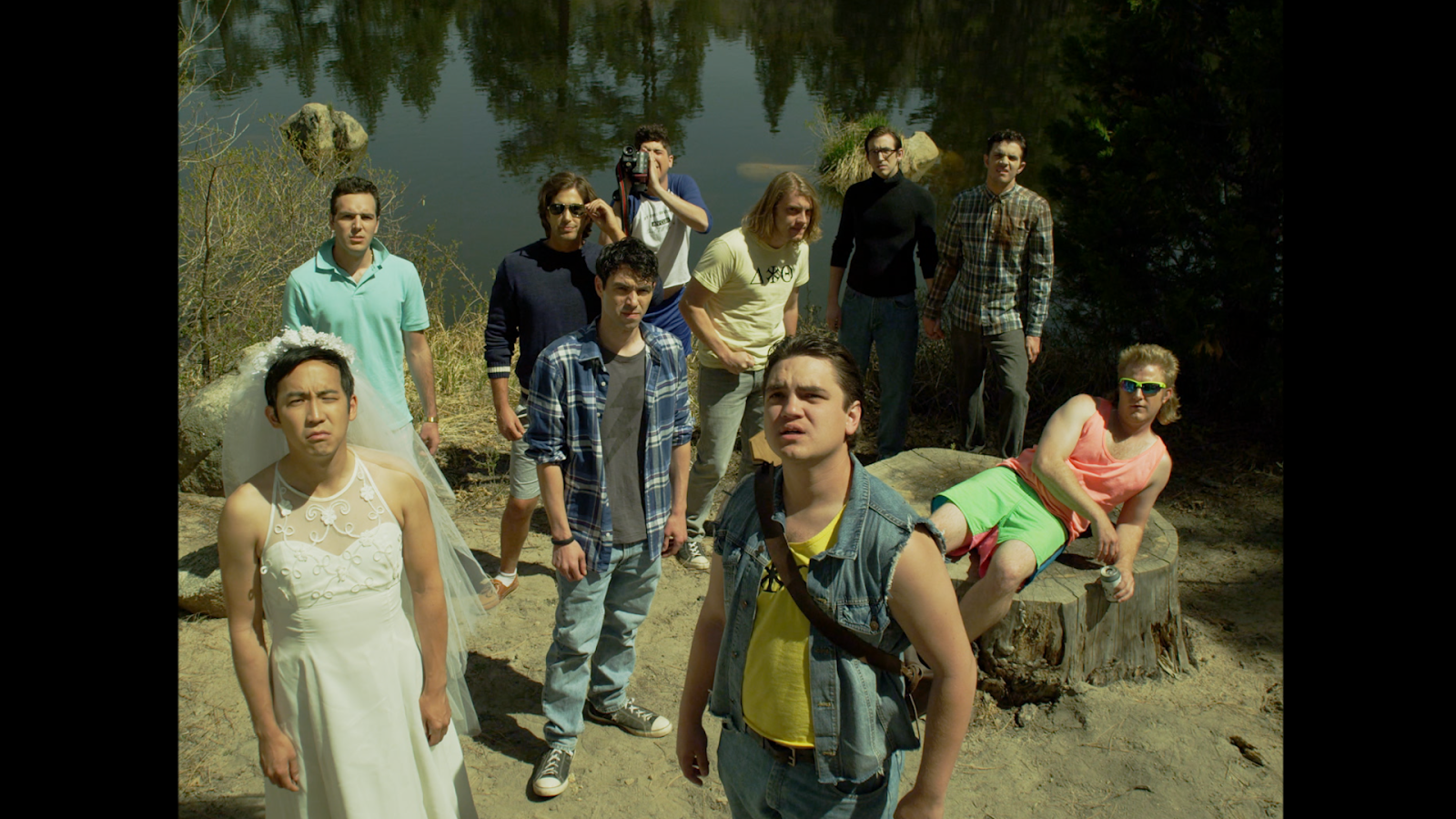
Now, at the dawn of Dude Bro Party Massacre 3, the identical twin brother of a previous victim of Motherface's rampage must infiltrate the frat house to find his brother's killer, and finally end the terror of Motherface. What follows is the most enjoyably silly take on the slasher genre you could hope for, complete with shirt ripping, dramatic monologues, nude tai-chi, and some wickedly funny dialogue. 


The true fun here is in the personalities. The filmmakers themselves fill out the roster of drunken louts that make up the frat house, and they're a lovable lot to watch on screen. Among the most memorable are Turbeaux, a high-energy freak played with a Jack Black-like zeal who beats pledges and is terrified of puppies, and Nedry, the wheelchair bound nerd who can't catch a break.

As the frat party head off to the lakeside house to inevitably get murdered, we also have a sub plot of a pair of police officers investigating the case, in their own special way. Officer Sminkle is a barely capable but kind hearted moron just about kept in line by the exasperated but eager-to-prove-herself officer Buttiker. These two are a great double act, give us just enough of a break from the frat storyline when needed, and Officer Sminkle just has some of the film's funniest lines. Appearing as the Police Chief is Patton Oswalt, and the smattering of celebrity is used perfectly, with just a perfectly fitting role and none of the ass kissing usually aimed at celebrities in smaller budget productions.


In short, Dude Bro Party Massacre 3 is exactly what you could want from it. It'll be your new guilty pleasure, your new party movie. A gory, offensive, foot stompingly funny time full of murders and unfortunate pledges and well-timed celebrity cameos. A mix of Kids in the Hall style comedy and Troma class gross out violence, with a surprising amount of heart. Most importantly, it feels like the filmmakers had fun making it, and that fun shows through in every scene. Just sit back and enjoy it, and join in the eternal speculation, what really goes on in the beef box? Will the world ever know?


Sunday, June 14, 2015

Review: The Witcher 3: The Wild Hunt


I have spent so much time so deep in a gritty fantasy world these last few weeks that I never knew if I’d find my way out again. The world of The Witcher 3: The Wild Hunt is so huge, and so complex, that it’s almost daunting at first. There’s so much to explore and such a huge world to get lost in you don’t know where to start. You just have to ride off on your trusty horse, Roach, and immerse yourself.

I spent more time in this world than I have in a game for a long time, a truly scary amount of time in fact, but now that it’s over, and the Wild Hunt has been defeated, I find myself thinking I wish it hadn’t ended already.

The more you play The Wild Hunt, the more exciting it becomes. The story starts with our hero Geralt of Rivia tracking his lost love Yennefer of Vengerburg across a broken no man’s land between two clashing empires. You ride through green plains, chasing giant soaring Griffins and hunting down bandits, and get to know the plight of the common man on the street whose life is shattered by the war, in ways both simple and huge. From mothers weeping over sons lost in the endless battles just over the horizon, to merchants getting rich from selling the belongings of the dead, everyone has an agenda here. It’ll be hard to go back to playing other RPGs after this, when the simplest quest has so much thought behind it. A quick example from the games very start: a Dwarven blacksmith in a rural hamlet has been forced to make weapons for the enemy Nilfgaardian invaders camped nearby. He had no choice in the matter, but one of the local human population used it as an excuse to commit a race hate act against the Dwarf, and burn his smithy down for being a traitor to his country. You find the arsonist, he’s just a hateful drunk who lost his family in the war. Does he deserve to hang for the crime if you turn him in? Will he commit more acts of aggression against undeserving people if you let him go? Regardless, if the Dwarf is assisted by Nilfgaard in repairing the damage done, the locals will hate him anyway. 


The sort of depth found in this little side quest is all through the game, with complex stories and lives touched upon in every little facet. Those who’re familiar with the previous Witcher games know to expect to confront issues with your own choices, issues like war, politics, sex and racism alongside the expected quota of slavering monsters to dispatch with your swords.

This is the final story in the world of the Witcher, and it has a lot to live up to. Seven books and three award winning games worth of characters and storylines have come to a head here, with a lot to do, and no time is wasted. From adventuring among the hills of Kaer Morhen with Vesemir and the other Witchers of the School of the Wolf, political intrigue with old enemy Sigismund Dijkstra, and guerrilla warfare alongside Vernon Roche, you’ll meet almost every character you remember, or forgot entirely, from previous incarnations of the source material. This can, of course, be overwhelming for some gamers, with a bit of a cutthroat attitude to lore present, and not much explanation given to times when the audience, especially English speakers who still haven’t had three of the books in the series translated yet, may have no idea who some of these characters are. This is noticeably present with the game's dominant story thread, the pursuit of Geralt’s ward Ciri. The complex relationship between Geralt and Ciri, and indeed Ciri and the majority of characters in the game, can be difficult to follow for those no well versed in the source material.

Not that the story is difficult to enjoy without this knowledge, of course. When characters are greeted as old friends or hated enemies by Geralt, it’s easy to take in stride and go along with it, as the subtext of dialogue is sharp and well written, without the need for distracting exposition or details. Indeed, it’s probably a lot better to simply wonder what a characters past might be than have a novels worth of prior plot-line shoved at you in awkward expositional dialogue. 

All the favorite characters have returned, with Geralt himself remaining exactly as Dandelion continues to describe him: Gruff, violent, yet possessed of a heart and humor like none other. Favorites proudly return, like the king of take-no-shit Dwarven one liners, Zoltan Chivay, and the endlessly patriotic Vernon Roche. Another enjoyable facet is that even amongst all the returning characters we know and love, the minor new characters are standout too. Like the inexplicably likable Nilfgaardian General Morvran Voorhis who’s just friendly as hell in a story that seems to be going on without him.  

The character I felt that, regardless of prior knowledge, we all needed to know more about, and indeed, should have seen more of in the game, was the emperor of Nilfgaard himself. To give him his full title, Emhyr var Emreis, the White Flame Dancing on the Graves of His Enemies, is the enigmatic despot behind the events of the second game. Where the average fantasy story would cast Emhyr as the clear villain, Geralt’s complex history with Emhyr places him in a unique position within the grey area of morality.


Masterfully voiced by Charles Dance, Emhyr is a brilliant character, equally supremely confidant and tortured, demanding of subservience yet righteously just. Each time Geralt met with Emhyr at his grand palace (after being washed and shaven and taught to bow properly in His Eminence’s presence), I enjoyed the scene, and wanted to see more of him and Geralt’s interesting interactions.

The same attention to character really can’t be said for the stories main antagonists however. The titular Wild Hunt, a foreboding army of semi-mythical Elven warriors, aren’t present enough to really seem significant. A huge part of the games run time is lived in fear of them, either running from them, chasing them, or searching high and low for information about them, but when we actually get to meet them, they aren’t all that impressive. There are some moments, like seeing what a Wild Hunt General does when he has a lot of drinks and an entourage of eager Succubi, but the majority of the Hunt, indeed even the arch villain Eredin himself, are absent in screen time as well as real personality.

The standout villains of the piece are without a doubt the secondary ones, the trio of sisters known as the Ladies. Three brilliantly creepy figures straight out of an old European fairytail. Either stunning naked young women one moment, or shockingly disgusting malformed crones the next, these three are by far the game’s most striking and memorable antagonists. They are introduced in an incredibly eerie scene talking to Geralt through a sinister weaving depicting their playful fairer selves, and yet the voices do not match the lovely faces we’re seeing by any stretch of the imagination. Each one has such brilliant, grotesque personality, I would have been happy to see the crones as the dominant villains all their own. 


The more I played the Witcher 3, the more I wanted to. It gets bigger as you go, with the world expanding from one rural hamlet to moving freely between an open countryside, with villages, cities, and swamplands to explore on foot or horseback, to mountainous Nordic islands that you can transverse by sailboat. As you explore in your search for Ciri, you’ll find yourself picking up Witcher contracts along the way, hunting down monsters for pay. Be it following the steps that led to a gruesome murder of a young woman, and summoning her angry spirit to lay her to rest, or following the bloody remains of a ruined miners camp to a Troll’s cookpot, many of these contracts are wildly different in style and scope. Some have great red herring twists, and some can be solved by simple dialogue alone (or by careful application of a bit of coin here and there).

There’s a string of new mini games to test yourself at, like fist-fighting or horse-racing, and an extensive card game, along with a seriously infectious card collecting aspect to it that swiftly becomes a serious habit. I can’t tell you how many times I ran into a new character, be told they were a powerful druid or a storied warrior, and immediately asked myself ‘But will they play gwent with me?!’


The whole game style has evolved significantly on from the Witcher 2, to be a little more RPG than action, almost a blending of the styles of the first and second games. Character development is more in depth, with many paths to take along the way, and far too many to reach out into in a single run. By the time you reach the endgame, you’ll only have enough attribute points to explore one of the five possible branches, and probably only half of it at most, so your Geralt may be wildly different from your friends. Geralt’s signs have been retooled significantly, making each one of major use in their own way, and some so good that an entire character can be built around use of one sign and its various abilities. Each sign now has multiple uses and upgrades to branch into, leading for a bit more variety in your spell-casting than in previous games.

Combat itself is also a whole new beat from the last game, with AI being a bit sharper, and a lot less vulnerable to hacking and slashing like a madman. Enemies dodge and weave, and counterattack, and you’ve got to be quick on your feet to dodge swipes and claws from monsters, and similarly quick to block and parry melee attacks from human opponents. The game is merciless on the harder difficulty settings, and it’s good to see a lot of rewarding ways to explore approaching combat than just pounding ability points into sword mastery.
Throughout your journey to find Ciri, you also get the chance to live through fragments of her own adventure trough her eyes, letting you play as Ciri in these scenes. These are a fantastic change from the gameplay as Geralt, as each character plays quite differently. Geralt is strong, efficient and methodical, whereas Ciri is impulsive wild, and incredibly powerful, and the game-play works as such, with Ciri moving at great speeds, teleporting around the battlefield in flashes of green light. It takes a moment getting used to at first, but soon you’ll love the chances you get to play as Ciri. CDProjekt Red have promised a wide assortment of downloadable support to the Witcher, and any such content featuring more time to play as Ciri would be incredibly welcome.


Any game this huge is not without its flaws, and the Witchers are all fairly merciful in the long run. I’d have loved more interaction with Eredin. For the final villain of a story this huge, he just wasn’t complex, and curiously enough, in a series that prides itself so much on breaking fantasy clichés, Eredin was very much the stock ‘dark lord’ archetype and not much more. 
Some curious issues seem to pop up in what I can only assume comes from the censorship of the game for the North American market. It doesn’t change the game at all, but certainly impacts scenes in an awkward way. Don’t have a character be told to strip naked, comment on the act of stripping naked, and then act as if they’re naked in the scene, when they are actually wearing underwear through the whole scene. It’s just weird, and makes you feel as if you’re playing an edited version.  
Some graphical bugs seem present too, but these end up simply being hilarious more than anything else. Occasionally the AI will bug out during a cut scene, and a character or object will turn up where it clearly isn't supposed to. In one choice example I encountered, during a heartfelt exchange between Geralt and Ciri, Morvran Voorhis wandered into the background where he stood there photobombing the drama for a while, before wandering off again to god knows where. It was great, but nevertheless ruined the moment somewhat. 


Upon finishing the Witcher 3, I realized I'd spent a long time lost in that world. I'd hunted down dozens of monsters, helped Elves and Dwarves and Halflings and a man named Dudu, I'd foiled political plots and battled dimension traveling Elves on a frozen pirate ship, and slept with as many sorceresses as I could. I would have tried to sleep with Dandelion too if they'd let me. I've played all three games, two of them several times over, I have lovingly read Sapkowski's original novels, and I even met a very beloved friend on the Witcher forum years ago. After I'd done all that, I still want more, and that's the best thing I can say about the world of the Witcher. I just don't want it to be over already.


Thursday, May 21, 2015

Movie Review: Mad Max: Fury Road


Taking one look at the theatrical poster for Mad Max: Fury Road, gives you all the suggestion you need that this won’t be what you expect.
The titular character is masked, facing off screen, his eyes fixed on something entirely different, and partially eclipsed by a shaven headed, badass woman in war paint. She’s close to us, her eyes fixed just beside us, right here with the problem at hand. There is a lot of meaning in that arrangement, as you'll soon see.


The post-apocalyptic genre has seen an awful lot of come and go over the decades, with sizzling hits and staggering failures throughout, all because it’s a polarizing genre. Not everyone gets or enjoys it, and some just can’t stand the bleakness of the concept. Sure, it’s bleak, morbid even, seeing the future of a destroyed world and the barren folk who still live there. For those with a taste for adventures taking place after the world as we know it, you pretty much can’t beat Mad Max: Fury Road. 

More so than any other film in recent years, Mad Max: Fury Road lives up to its title. Usually the words after the colon in a film title seem to be chosen entire at random, like they just chucked a bunch of words like ‘Redemption’ and ‘Revelations’ into a bingo machine and just had at it.
In Mad Max, you better believe there’s a road. And damn is it fucking furious. Right from the ass-kicking opening, our titular hero being captured by crazed white painted desert marauders, you can’t be ready for the chaos that will ensue, as before you know it, you’re thrust along on a 2 hour non-stop, high speed car chase through the wastelands of the world that once was. 

Max has been captured by the foot soldiers of Immortan Joe, the god-like leader of his own personality cult filling an entire city. Immortan Joe holds the thousands under him in rapturous worship, controlling all the water and all the power in the known region. Organizing cargo runs that control the supply of bullets and gas with sister cities across the wastelands, Joe is master of all he surveys, most of all leading the white painted Warboys who serve his wishes with an obsessed zealotism.


Setting his latest tanker full of supplies off on a run across the wastes, Joe basks in the idolatry from his audience, unaware that what he holds most dear is being smuggled out from under his nose by his most trusted of soldiers, the one armed sharp shooter Furiosa.
When Furiosa turns off the planned course in her tanker, taking the precious cargo contained within, the enraged Joe gathers a force unlike the world has ever seen to reclaim his property. The poor-fortuned Max, currently being used as a living blood bag to a sickened warboy, is dragged along, and strapped to the helm of one of a thousand revving cars, trucks and crazed automobile monstrosities that blast out to give chase after Furiosa. From that point on, all you can do is hold on for the ride.

There are great characters at play through the action, and they’re a huge part of what makes the film so enjoyable. Furiosa, the driving (badum-tish) force behind the heroes, is as strong a character as you’ll see on screen today. A brutal woman with a shattered past, a killer shot, and a Mean-Machine style mechanical arm, it’s tough to take your eyes off her. 


The villains of the piece are works of art in themselves. Immortan Joe himself is the echo of a military general crossed with a spiritual leader, bearing a booming voice and a horrific breathing apparatus rigged to his face. He’s a great villain, not just for his silver tongue and commanding screen presence, but because he leads the forces of the wastelands at every turn personally, he’s a constant threat at the heels of the heroes, not a distant enemy, and it makes him a far more enjoyable villain.
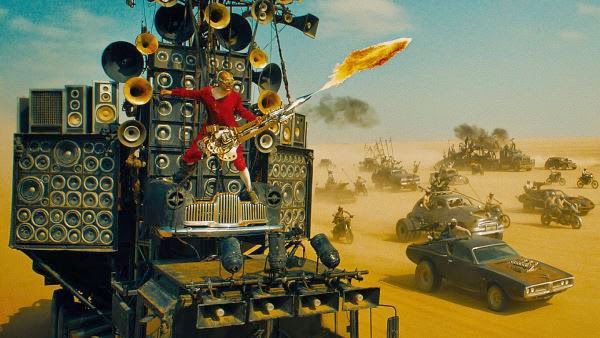
Another fascinating personality at play amidst the chase is Nux, one of Immortan Joe’s warboys. Young, feisty, and desperate to please his beloved Joe by any means, Nux drives a flaming classic car armed with explosives and a death wish. Nux is a wonderful alternate viewpoint to see the events of the film through. So different from the cold, determined logic of Furiosa, Nux is impulsive, obsessive and blinded by worship. The travels of Nux through the story is one of the films highlights.
Lost amidst the races and flames and fire blasting guitar players suspended from trucks? Max himself is there too. It’s easy to forget the unfortunate man strapped to the front of Nux’s car. 


Max is an interesting spin on the classic action hero. He’s not as good a driver as Nux, he’s not as skilled a shot as Furiosa. He has no personal vendetta against Joe, he doesn’t know where he’s going, and he’s just along for the ride. He barely grunts a few lines of dialogue through the entire film. Thrust through the storyline set into motion by Furiosa, and contested between her goal and her enemies, Max is a lost soul who we can watch the crazed proceedings through, who never overshadows the rest of the cast. The titular hero is not the most interesting character, so in a remarkably wise writing choice, isn't hamfisted into being main focus. 


The closest thing I can compare Mad Max: Fury Road to, is a great anime film. The old ones, the ultra-violent, apocalyptic worlds populated by the most crazed, disfigured villains you’ve ever seen. Watching Mad Max put me back in the place of unique excitement I first found watching Violence Jack or MD Geist as a kid, that crazy, wild fun that you almost don’t believe you’re seeing for a moment. From start to finish, it’s larger than life, it’s noisy and wild, and It. Does. Not. Stop.

Wednesday, April 22, 2015

Movie Review: Age of Ultron


When I was 7, my dad gave me a pile of his old comics from when he was a kid. I had Captain Britain, The Defenders, and Dan Dare amongst many others, and I had a lot of favorites. The character that leapt off the page at me though, the character that stuck with me ever since; was the philosophical, maniacal robotic arch nemesis of the Avengers, Ultron.
You can imagine how excited I was when Ultron was revealed as the antagonist in the sequel to Marvel’s immensely successful The Avengers. When his actor was revealed as James Spader, with his gravelly southern voice, I was at first skeptical. I was expecting the announcement to be of an actor with a famously recognizable voice, like Malcolm McDowell.
The moment I saw that first trailer, all my fears were put to rest. Spader’s commanding drawl is so perfectly condescending, intellectually superior, even bored sounding, it fit the character wonderfully.
From that moment on, going into this one, I was excited.
I was not disappointed.
With every step forward into Marvel’s Cinematic Universe, it feels more like the spirit of the comics. From the very beginning, we see the Avengers working together as a coordinated team battling their old enemies Hydra. It’s fluid, and fun and incredibly put together visually. Each member seems to have been developed since the last film, both in the way they function within the team, interacting with their fellow members, and how they act on a personal basis. We see a little more of everyone here, more personal scenes, more fight scenes, more everything.
Most of all, this is a character based movie. It’s wall to wall action, sure, but everyone has their moment of drama, and the dialogue is well written for pretty much every personality involved. It isn’t just Iron Man starring the Avengers anymore, every character has screen time on and off the field of combat. 


Not an easy feat, considering they are juggling five popular main characters, and some major satellite characters too. While Downey Jr’s Stark is still the funniest character in the film, with comebacks and dialogue so sharp and well delivered it almost seems improvised, there’s also great moments from the supporting cast, Don Cheadle’s War Machine standing out in his scenes by far. Conspicuously absent amongst the ensemble are fan favorites (and eternal girlbait) Agent Coulson and Loki, however.
There’s great scenes of casual interplay between the Avengers. The snappy dialogue in hectic combat is even better in casual situations, with great scenes of macho competition, honest flirtation, and scientific ambition. It’s difficult not to love each of the Avengers, with even the less focal ones getting great scenes here.
No time is wasted on early exposition, or introducing characters we already know. The setup is here and ready from point one, and it doesn’t take long for the main plot to kick in after the brilliant opening scene. During a celebratory party in the Avenger’s tower, the first form of the titular villain shows himself. 


At first I was taken aback by the frank quirkiness of Ultron’s dialogue. There’s no technobabble or stereotypical ‘robot character’ dialogue, he’s very human. He’s cocky, even funny. I realized that the character, a product of alien technology mixed with Tony Stark’s automated Iron Army program, has taken on some of Stark’s personality traits, and shares his cynical, comical side. It works. Ultron is an enjoyable villain to watch, he talks like Stark, with his constant megalomania and superiority turned up to eleven. His first scene, analyzing the simple flaws in the existence of the world as we see it, is just brilliant.
By instantaneous access to all the worlds information, Ultron goes from birth to master plan in a matter of minutes, so it all kicks off pretty soon from there on, with a globetrotting series of events pursuing Ultron across the world. The story is kinetic, never staying in one place for long. The Avengers are dragged through a series of trials, facing more new enemies in the Maximoff twins, not named as such here but better known to comic fans as Quicksilver and Scarlet Witch. These two are more enjoyable than I expected, having never been a fan of either before. With some acceptable neutral Slavic accents, they form the basis of Ultron’s cadre of main antagonists. Quicksilver snatching arrows out of the air with his super speed and Scarlet Witch bending the minds of our heroes to show them their worst fears. With a team of heroes as powerful as the Avengers, turning them against one another has long been the classic way to deliver a challenge.
Quicksilver’s inclusion will inevitably be compared to the characters recent appearance in X-Men: Days of Future past, and I have to say, regardless of some fun visual gags, he isn’t half as exciting here. In DOFP, we saw incredible use of the characters super speed in a variety of ways, Age of Ultron’s Quicksilver is just not up to that standard, although he is well performed and enjoyable to watch.


The twin’s inevitable heel/face turn is one of the movies short order points, in my opinion, a little brief, and they are awfully quick to ally with a character that was revealed in a prior monologue to be the source of a lifetime of constant fear and oppression for the two. Also, without the twins as sidekicks, Ultron is the lone antagonist for most of the films runtime, and as great a villain as he is, there’s something video-gamey about the Avengers battling an endless supply of identical robot drones. These large scale battle scenes, all inclusive of almost every character, are a visual masterpiece, certainly, but they don’t have the urgency or intensity necessary in a lot of the situations. We know any member of the Avengers will defeat a hundred of these enemies in a scene like this, so there’s no genuine threat there. The real joy in the films battle scenes come from other sources, like the brilliant punch up between a pissed off Hulk and the long awaited Iron Man Hulk-Buster armour. This one is fantastic. Hulk is his absolute finest here, made genuinely scary by showing us that he isn’t just the strongest thing on the battlefield, but that he’s fast too. Iron Man attempting to stop the rampaging green menace whilst simultaneously trying to protect the undefended city and the populace around them is just great, and will be the main event of the film for many viewers.
The Hulk has a lot of character development here, and along with Black Widow and Hawkeye, forms the Avengers that we see a much more intimate side of. An emerging romance and personal secrets  are introduced that we hadn’t previously seen, and it serves to remind there’s a lot more going on here than just saving the world. 


Speaking of which, the exact peril the world is in, isn’t as clear as it perhaps could have been. Exactly what Ultron’s plan was I felt wasn’t all that obvious until the films finale. It feels at times like the storyline is moving to a time limit we aren’t really seeing. It doesn’t make it any less fun, but the real feeling of tension generated by threat through the second act just wasn’t there.
The film’s final act introduces a major hero in the form of one of the comic’s most mysterious, enigmatic characters. If you’ve made it this far without knowing who that is, I don’t want to spoil it for you. I’ll say he’s played beautifully, with just the right edge of childlike wonder and enlightened gravity that the character needs, by a brilliant British actor who has long deserved a role so big. One perfectly played moment in his first scene had the whole audience cheering, and you’ll know it when you see it.
Age of Ultron may not be the epic entry in the MCU it could have been. It serves to develop characters and move the whole story forward rather than end anything or bring it all together, but it’s sharply written, well put together, and has some truly enjoyable performances by characters both old and new. There’s so much going on in the MCU, with developments in this film leading to at least 4 separate future films, and it’s hard not to want to get involved in all of them. It’s just like reading the comics, you can’t read only one, there's too much fun to be had by diving right into the whole world.