It was ten thirty on the corner of Franklin and Los Palmas when I encountered one of Hollywood's superheroes.
I had been minding my own, keeping watch for a parking space amongst the nose to tail rows either side of the road. Parking was a nightmare in Hollywood in this season. Harrison Ford was in town for the premier and the tourists were thick.
The road was busy with cars looking for spots to ram themselves into like salmon, and I stared down at the floor beneath me, contemplating the folds in my long leather coat. Then it seemed a strange quiet fell upon the area, and I looked up to meet the wide eyes of a strange individual standing beside me. How had they got there so quick or so quietly? I can only assume metahuman powers.
"Hey." Came an elegant voice. Between two fingers the newcomer toyed with a bright green piece of candy.
"Evening." I replied, looking them over with a quick glance. No cars seemed to pass anymore. The night was quiet, time suspended.
The strange individual was wearing knee high black riding boots that just fit under the rim of a black skirt that flailed around long legs in the wind. Hips were held in a tight belt, into which was tucked a pink corset top featuring some pretty boastful cups. Blond hair fell over shoulders.
"Do you fight crime?" Came the voice again.
There was a moment before I responded where I tried to look into the big blue eyes that shone out from behind the wide black masquerade mask upon the strangers face, but I regained my composure.
"Not professionally, no." Said I.
"Oh." The stranger said, somewhat disappointed. "Because there was a pretty big thing over here a few days ago, with some pretty bad guys."
The big eyes swept my coat.
"Thought I saw you there. Are you not with the rest of the Hollywood superheroes?" A gloved hand came up to stroke at a powerful chin that bore the faint stubble of a few days without a razor.
"No." I responded, my accent obvious. "I'm from out of town."
"Oh, a crossover? Then welcome to Hollywood. I'm Elizabeth."
Elizabeth extended a slender hand, which I shook reluctantly, fearing her inevitable super strength.
"But most people around here call me..." She paused, her voice dropping conspiratorially, "The Black Canary."
I nodded in recognition, shaking the offered hand.
"If you ever need me, I'll be over there." She said, raising a cigarette to her lips and walking away with a soft sashay to the broad hips. The Black Canary strode across the road, her heels clicking through the parking lot, and into the void between the park and a huge storage canister. The darkness enveloped her entirely. After a moment the softly glowing flare of a cigarette could be seen.
Hollywood was in good hands.

Saturday, April 13, 2013

Sunday, January 13, 2013
Chimps
The members of the board at the Los Angeles Zoo sat about their wide table and once again got into the same debate they always did. Was it really the best course of action for every animal in the zoo to be a chimp?
Of course it had started out as a brilliant cost cutting maneuver. The chimps that had been taught to operate the elephant suit were efficient, much easier to feed than the elephant, and seemed to genuinely enjoy their job. It took eight chimps to operate the complex elephant outfit, stomping around the elephant enclosure, hooting and making elephant noises, and the public was none the wiser. Soon it was a simple process to slowly begin converting all the large mammals to chimp operated exhibitions. The giraffes were a task, but the chimps took well to the tutorship of balancing on one anothers shoulders within the neck of the costume and operating the mouth and eyes.
The board of directors looked around at one another and finally the inevitable question was raised.
"What else can we put the chimps to work as?" The deputy director asked his fellows. The large mammals had been only the beginning of course.
Each chimp enjoyed his or her work, being paid a double ration of bananas, and taking advantage of the chance to better themselves. The chimps in the gazelle costumes had learned to run fast. The chimps in the lion costumes were adept at replicating the subtle menace of the big cats flawlessly. The alligators were specially trained chimps in wetsuits and breathing equipment.
Trouble had arisen when the smaller creatures came up for review, and it was decided that if possible they should be replaced by more chimps.
"But what of the size concerns?" Came the troubled query from a board member. "No chimp can possibly operate a five inch wide stony toad costume effectively!"
There had been much stroking of chins and comparing of possible answers over that one. The final solution had simply been to construct larger sized costumes and place the exhibits behind craftily distorted glass to distort the apparent size of the creatures to the viewing public. Once more, they were none the wiser. Even most of the chimps were now chimps in other chimp costumes. Chimps that desired to explore their sexuality or their roles in society by changing appearance within the boundaries of their own species.
Four hundred chimps now worked and operated within the confines of the LA Zoo. There were virtually no other animals left.
A janitor had entered the board room and began his sweeping of the floors surrounding the table. The deputy director watched as the man swept calmly, arranging the dust and debris from a week of debate into neat piles. Something about the way the man's skin held to his joints was odd though, as if he were not a man at all.
The deputy director narrowed his eyes and watched the other members of the board.
"Surely not," he said, his voice tinged with concern.
The other members of the board looked back at him with an almost curious expression.
"But of course." Came the voice of the Zoo Director. He smoked a cigar and rapped his fingers on the table. "Why, a regular man would want his hourlies and his salaries, his time off and his lunch breaks. These fine chimps only want their bananas and the chance to better themselves. Why, what greater challenge to the charming animals than to learn the subtle nuances of the human being?"
The janitor gave a curt nod to the assembled board of directors, and left, sweeping his neat piles out with him. The door closed behind him.
The deputy director watched as the chairman of the science committee pulled a banana from her pocket and began to eat it in silence.
"Then, fellow members of the board, I ask you: Are there any among you who are not chimps in the skins of my dead fellow board members?" The deputy director looked warily about as the other board members exchanged glances, nods, shrugs.
The Zoo director crushed out his cigar on the table before him and dusted his hands, the skin fitting just a little tight over his long simian fingers. The deputy director noticed only now, the Zoo director's accent was not the perfect Brooklyn twang anymore, but a practiced actor's estimation thereof.
"Then, It seems there is only one job left for the chimps to be put to," he said.
The deputy director tried to rise from his seat, but the chimps were already upon him.
Of course it had started out as a brilliant cost cutting maneuver. The chimps that had been taught to operate the elephant suit were efficient, much easier to feed than the elephant, and seemed to genuinely enjoy their job. It took eight chimps to operate the complex elephant outfit, stomping around the elephant enclosure, hooting and making elephant noises, and the public was none the wiser. Soon it was a simple process to slowly begin converting all the large mammals to chimp operated exhibitions. The giraffes were a task, but the chimps took well to the tutorship of balancing on one anothers shoulders within the neck of the costume and operating the mouth and eyes.
The board of directors looked around at one another and finally the inevitable question was raised.
"What else can we put the chimps to work as?" The deputy director asked his fellows. The large mammals had been only the beginning of course.
Each chimp enjoyed his or her work, being paid a double ration of bananas, and taking advantage of the chance to better themselves. The chimps in the gazelle costumes had learned to run fast. The chimps in the lion costumes were adept at replicating the subtle menace of the big cats flawlessly. The alligators were specially trained chimps in wetsuits and breathing equipment.
Trouble had arisen when the smaller creatures came up for review, and it was decided that if possible they should be replaced by more chimps.
"But what of the size concerns?" Came the troubled query from a board member. "No chimp can possibly operate a five inch wide stony toad costume effectively!"
There had been much stroking of chins and comparing of possible answers over that one. The final solution had simply been to construct larger sized costumes and place the exhibits behind craftily distorted glass to distort the apparent size of the creatures to the viewing public. Once more, they were none the wiser. Even most of the chimps were now chimps in other chimp costumes. Chimps that desired to explore their sexuality or their roles in society by changing appearance within the boundaries of their own species.
Four hundred chimps now worked and operated within the confines of the LA Zoo. There were virtually no other animals left.
A janitor had entered the board room and began his sweeping of the floors surrounding the table. The deputy director watched as the man swept calmly, arranging the dust and debris from a week of debate into neat piles. Something about the way the man's skin held to his joints was odd though, as if he were not a man at all.
The deputy director narrowed his eyes and watched the other members of the board.
"Surely not," he said, his voice tinged with concern.
The other members of the board looked back at him with an almost curious expression.
"But of course." Came the voice of the Zoo Director. He smoked a cigar and rapped his fingers on the table. "Why, a regular man would want his hourlies and his salaries, his time off and his lunch breaks. These fine chimps only want their bananas and the chance to better themselves. Why, what greater challenge to the charming animals than to learn the subtle nuances of the human being?"
The janitor gave a curt nod to the assembled board of directors, and left, sweeping his neat piles out with him. The door closed behind him.
The deputy director watched as the chairman of the science committee pulled a banana from her pocket and began to eat it in silence.
"Then, fellow members of the board, I ask you: Are there any among you who are not chimps in the skins of my dead fellow board members?" The deputy director looked warily about as the other board members exchanged glances, nods, shrugs.
The Zoo director crushed out his cigar on the table before him and dusted his hands, the skin fitting just a little tight over his long simian fingers. The deputy director noticed only now, the Zoo director's accent was not the perfect Brooklyn twang anymore, but a practiced actor's estimation thereof.
"Then, It seems there is only one job left for the chimps to be put to," he said.
The deputy director tried to rise from his seat, but the chimps were already upon him.
Saturday, October 20, 2012
Live Show: Covenant.
Covenant know how to put on a show.
The small stage that fits the three members of Sweden's premier electro-industrial band is bathed in red light as the band prepare themselves for the coming spectacle. They don't need pyrotechnics, or dancers. They are simply practiced and pure in honest energetic performance. The great width and depth of the room, crowded with black draped mohawked industrial fans wedged shoulder to shoulder, managing to stay quiet; speaks to the anticipation.
Eskil Simonsson could have started a religion. Looking like the electronic world's answer to David Bowie in a sharp fitted suit, tie, and side swept short blonde hair, he steps on stage a first seeming frail, hand on a cane, but as the show begins, energy pours forth from him.
"Can you dig it?" He asks us in his bassy Swedish accent, his hand held high. His whole persona exudes irresistible charisma and charm, like a preacher before his flock. Simonsson has one thing up his sleeve I've never seen any other performer do so well on stage, and that is inspiring his audience. His confidence seems to cover no ego, and everything he does in his performance is aimed at sharing the energy and the strength with his crowd. He seems to draw energy into himself and feed it back out.
The beats lash out over the crowd as he asks us "Who are you? Who do you want to be? What's stopping you?"

He is endearing, and constantly making the crowd smile. Even returning to the stage at one point armed with a handful of water bottles, barking "Sharing is caring!" and tossing them into the front row. One moment in the set that gave me a swell of admiration for the front-man was quite unscripted- halfway through the band's hour and a half set, a fan scrambles up stage left and attempts to embrace Eskil. The kid is snatched by security barely a step onto the stage, and roughly tugged away. Without missing a note, Eskil taps the security guard on the shoulder and motions with his hand: 'Go easy'. Good man, there.
For those who are fans, which is pretty much everyone in the electronic or industrial scene, you will notice that Covenant sound very different live. Eskil's voice dominates the set. This is so conductive to his center stage antics that no-one will be put off by the change. Indeed, the crowd is practically mesmerized. The response to his calls and supplication that 'We are playing for you!' is resounding agreement from the whole room. The place falls into a deep rhythm as the practiced showmen go about their set, and gives off a mighty cheer at the beginning of fan favorite 'Call The Ships To Port'. Dipping into their latest release for the finale, the show swells to a climax. Eskil slowly retreats from the lights, reclaims his cane, and is gone into the darkness.
Every industrial fan in Los Angeles crawled out from under their respective rocks for this show. The wave of people leaving the venue onto Pico Boulevard at 2AM looks like a lunatic convention. We spot a tall old rivethead with an Einstürzende Neubauten shirt that has probably been worn since before I was born. All is energetic on this layer tonight..
The small stage that fits the three members of Sweden's premier electro-industrial band is bathed in red light as the band prepare themselves for the coming spectacle. They don't need pyrotechnics, or dancers. They are simply practiced and pure in honest energetic performance. The great width and depth of the room, crowded with black draped mohawked industrial fans wedged shoulder to shoulder, managing to stay quiet; speaks to the anticipation.
Eskil Simonsson could have started a religion. Looking like the electronic world's answer to David Bowie in a sharp fitted suit, tie, and side swept short blonde hair, he steps on stage a first seeming frail, hand on a cane, but as the show begins, energy pours forth from him.
"Can you dig it?" He asks us in his bassy Swedish accent, his hand held high. His whole persona exudes irresistible charisma and charm, like a preacher before his flock. Simonsson has one thing up his sleeve I've never seen any other performer do so well on stage, and that is inspiring his audience. His confidence seems to cover no ego, and everything he does in his performance is aimed at sharing the energy and the strength with his crowd. He seems to draw energy into himself and feed it back out.
The beats lash out over the crowd as he asks us "Who are you? Who do you want to be? What's stopping you?"

He is endearing, and constantly making the crowd smile. Even returning to the stage at one point armed with a handful of water bottles, barking "Sharing is caring!" and tossing them into the front row. One moment in the set that gave me a swell of admiration for the front-man was quite unscripted- halfway through the band's hour and a half set, a fan scrambles up stage left and attempts to embrace Eskil. The kid is snatched by security barely a step onto the stage, and roughly tugged away. Without missing a note, Eskil taps the security guard on the shoulder and motions with his hand: 'Go easy'. Good man, there.
For those who are fans, which is pretty much everyone in the electronic or industrial scene, you will notice that Covenant sound very different live. Eskil's voice dominates the set. This is so conductive to his center stage antics that no-one will be put off by the change. Indeed, the crowd is practically mesmerized. The response to his calls and supplication that 'We are playing for you!' is resounding agreement from the whole room. The place falls into a deep rhythm as the practiced showmen go about their set, and gives off a mighty cheer at the beginning of fan favorite 'Call The Ships To Port'. Dipping into their latest release for the finale, the show swells to a climax. Eskil slowly retreats from the lights, reclaims his cane, and is gone into the darkness.
Every industrial fan in Los Angeles crawled out from under their respective rocks for this show. The wave of people leaving the venue onto Pico Boulevard at 2AM looks like a lunatic convention. We spot a tall old rivethead with an Einstürzende Neubauten shirt that has probably been worn since before I was born. All is energetic on this layer tonight..
Movie Review: Sinister.
It takes a damn good horror movie to give me a chill these days. Modern horror mostly forgoes the classic horror techniques of tension, dread and atmosphere, and instead focus on jump scares and gore. It's a hell of a refreshing feeling when one comes along that uses tension as its primary driving force, and Sinister really did just that. The story is a simple one, it never over-complicates itself. It is essentially a haunted house tale. It certainly has its turns, and a twist that I actually didn't see coming for once, but mainly Sinister is a treatment in darkness and tension. The film's cold opening is absolutely perfect in this respect. A quiet view of a family being hung from a tree, bags over their heads, in silence. It feels uncomfortable and voyeuristic, and already we're in the world of Sinister's grisly background.

Our tortured hero is true crime novelist Ellison, played by an almost unrecognizable Ethan Hawke. I say unrecognizable not because of his facial hair, but because he genuinely did a great job of disappearing into the role of an everyday family man-slash-true crime novelist. He's an enjoyable character to get to know, and that's a good job as we do spend a solid hour and a half of the two hour run time with him alone. He may not be the best of family men, as he has dragged his family along with him on his latest project, which includes relocating them into the house of a recently murdered family. He's likable though; he swears, he drinks. He argues with his bitchy wife and noisy kids. He worries about his writing and his skill and his ability to provide for his family. He is believable.
As night falls upon Ellison in his new house, we come to the meat of the whole story, and that is the box of home footage mysteriously left behind in the attic. Watching back the old super 8 films on a noisy projector (In his office. Alone. In the dead of night.) Ellison observes four tapes of morbid events that will stick with you long after you've left the theater. These tapes are where the film shines its grisly darkest.
What Ellison has stumbled upon are the home videotapes chronicling a series of murders. Each tape begins with a family about their daily lives, watching TV, playing by the pool, in the back yard, before each one then changes abruptly to the moment the family was murdered. This is no monster movie junk either, these are commonplace, incredibly realistic methods of death. The way people could be killed any day of the week, anywhere, by anyone. These tapes are nasty, disturbing and you can't fucking look away.
At this time I'll also have to point out the film's score, which did wonders for the atmosphere. The hectic life of Ellison is accompanied by strange, almost a melodic tones just as erratic as his life, whilst the viewing of the tapes are wallowing in a haunting distorted chant. The music is never invasive or dominating of the scene, it is just there, and calculatedly compliments the visuals.

Ellison is disturbed by his discoveries in the tapes, leading him on a frenzied search for further clues and links between the murders. By sheer accident, he stumbles upon a thread between them. It is here that Sinister introduces its antagonist, the Freddy, the Leatherface etc. A leering figure appears in each video, if only for a frame or so- the only apparent connection between the crimes. Clues begin to be dropped from here on in that tie up the film's twist awfully nicely, and I admit I was thrown by it. So many red-herrings are so carefully placed that nothing feels forced or obvious. Are we really watching what's going on with Ellison's family whilst he and his wife argue over the night terror outbreaks of his teenage son? We should be.
The entity within the pictures, as well as the appearance of an iconic occult symbol (A great bit of graphic design, whoever was responsible for that. I see tattoos happening.) leads Ellison to contact the helpful professor of occult studies at the local university (What university is this? Miskatonic?) to find more information. Naturally, Ellison gets more than he bargained for.
I liked how they handled their villain. The problem with so much horror is that nothing remains scary for long. Once we've seen a killer take out his victims scene after scene through a feature length show, we've long lost any fear of mystery. The mysterious figure in the tapes, a Babylonian deity known as Bughuul, is rarely used, almost never directly seen, and rarely even mentioned. He retains the mystery factor right till the end of the film. We know sparse, scattered details of the entity. But we do find out that so little information exists about him, as it has all been destroyed in superstitious paranoia. You see, Bughuul exists within any image of himself, and from those images his influence can be exerted. Possession. Abduction. Even manifestation. Ellison learns about this long after he's watched the tapes and placed images of the entity upon his walls. Brilliant.

Some might not like how Sinister wraps up. It is certainly unexpected, and unlike the rest of the film's slow subtle pace, the finale takes its final turns at breakneck speed and is over before you even realize it. That's the definition of a crescendo of course, and I think it fit. It's ballsy, it doesn't bail out on its convictions at the last moment like you expect it to. The story is told and it all ends in a bloody flash.
Sinister will fill a bit of the gap left by shitty modern horror films. If things go this way, perhaps we'll start seeing a change in the genre, which more than any other out there, desperately needs a shot in the arm to stay alive.

Our tortured hero is true crime novelist Ellison, played by an almost unrecognizable Ethan Hawke. I say unrecognizable not because of his facial hair, but because he genuinely did a great job of disappearing into the role of an everyday family man-slash-true crime novelist. He's an enjoyable character to get to know, and that's a good job as we do spend a solid hour and a half of the two hour run time with him alone. He may not be the best of family men, as he has dragged his family along with him on his latest project, which includes relocating them into the house of a recently murdered family. He's likable though; he swears, he drinks. He argues with his bitchy wife and noisy kids. He worries about his writing and his skill and his ability to provide for his family. He is believable.
As night falls upon Ellison in his new house, we come to the meat of the whole story, and that is the box of home footage mysteriously left behind in the attic. Watching back the old super 8 films on a noisy projector (In his office. Alone. In the dead of night.) Ellison observes four tapes of morbid events that will stick with you long after you've left the theater. These tapes are where the film shines its grisly darkest.
What Ellison has stumbled upon are the home videotapes chronicling a series of murders. Each tape begins with a family about their daily lives, watching TV, playing by the pool, in the back yard, before each one then changes abruptly to the moment the family was murdered. This is no monster movie junk either, these are commonplace, incredibly realistic methods of death. The way people could be killed any day of the week, anywhere, by anyone. These tapes are nasty, disturbing and you can't fucking look away.
At this time I'll also have to point out the film's score, which did wonders for the atmosphere. The hectic life of Ellison is accompanied by strange, almost a melodic tones just as erratic as his life, whilst the viewing of the tapes are wallowing in a haunting distorted chant. The music is never invasive or dominating of the scene, it is just there, and calculatedly compliments the visuals.
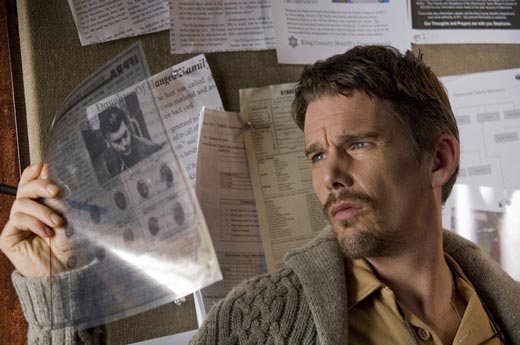
Ellison is disturbed by his discoveries in the tapes, leading him on a frenzied search for further clues and links between the murders. By sheer accident, he stumbles upon a thread between them. It is here that Sinister introduces its antagonist, the Freddy, the Leatherface etc. A leering figure appears in each video, if only for a frame or so- the only apparent connection between the crimes. Clues begin to be dropped from here on in that tie up the film's twist awfully nicely, and I admit I was thrown by it. So many red-herrings are so carefully placed that nothing feels forced or obvious. Are we really watching what's going on with Ellison's family whilst he and his wife argue over the night terror outbreaks of his teenage son? We should be.
The entity within the pictures, as well as the appearance of an iconic occult symbol (A great bit of graphic design, whoever was responsible for that. I see tattoos happening.) leads Ellison to contact the helpful professor of occult studies at the local university (What university is this? Miskatonic?) to find more information. Naturally, Ellison gets more than he bargained for.
I liked how they handled their villain. The problem with so much horror is that nothing remains scary for long. Once we've seen a killer take out his victims scene after scene through a feature length show, we've long lost any fear of mystery. The mysterious figure in the tapes, a Babylonian deity known as Bughuul, is rarely used, almost never directly seen, and rarely even mentioned. He retains the mystery factor right till the end of the film. We know sparse, scattered details of the entity. But we do find out that so little information exists about him, as it has all been destroyed in superstitious paranoia. You see, Bughuul exists within any image of himself, and from those images his influence can be exerted. Possession. Abduction. Even manifestation. Ellison learns about this long after he's watched the tapes and placed images of the entity upon his walls. Brilliant.

Some might not like how Sinister wraps up. It is certainly unexpected, and unlike the rest of the film's slow subtle pace, the finale takes its final turns at breakneck speed and is over before you even realize it. That's the definition of a crescendo of course, and I think it fit. It's ballsy, it doesn't bail out on its convictions at the last moment like you expect it to. The story is told and it all ends in a bloody flash.
Sinister will fill a bit of the gap left by shitty modern horror films. If things go this way, perhaps we'll start seeing a change in the genre, which more than any other out there, desperately needs a shot in the arm to stay alive.
Saturday, September 22, 2012
The Captain's Painting
Field report, Addressed to: Major-General Sir Colin Gubbins.
Care of British commonwealth Armed forces, North African RAF base designation 'Firefly'.
From: Captain A. Lysander. 2nd African Auxiliary unit.
17th of April, 1941.
It is with a mix of profound relief and distinct uncertainty that I hereby offer my complete and concise report concerning the death of SS-Oberfuhrer Aldrik Faust and my team’s successful dissolution of his operations in North Africa. I understand my previous telephone report was somewhat indistinct with details, as some of the events that transpired in our mission were difficult to reasonably describe, at best. The file I have attached details the basics on what we know of Faust, and how he escaped justice previously after his involvement with the SS special projects unit of '39, regarding the advanced weaponry experiments. Intelligence had followed his actions closely since those events, and his movements were impossible to ignore. Faust was a close confidante of SS-Reichfuhrer Himmler, and was no doubt trusted with the height of secret information regarding the SS-special projects operations. It is a shame we couldn't apprehend him alive, as his information would have been undoubtedly valuable, but as you will read, due to circumstances surrounding his confrontation, this was quite impossible. In summation, the operation was a success, apart from, of course, the regrettable loss of Private Thomas and Sgt. Styles. I write to you now from Northern command, eagerly awaiting our return to Europe.
Let me begin my report by detailing the arrival at the RAF base 'Firefly' in North Africa. My team consisted of myself, my most trusted friend Lieutenant Robert Reese, Sergeant Mark Styles; communication specialist, Private Richard Wake; our driver, Corporal Howard Andrews; sharpshooter, Private Arnold Thomas; and Lance Corporal Edward Redden; Medic. I imagine they can get away with calling Firefly a base because there was a British flag or two in the air, a few Crusader class tanks doing the rounds, but otherwise might've well been a watering hole. I can't imagine trying to land anything there, and as we arrived by road I thought we were passing a small group on maneuvers until I saw the tents. The base hadn't seen proper communication in a full week, according to Major Colson; the current commanding officer and the majority of manpower here was simply redirected from the main base to the north engaging the AXIS forces. The paltry situation of the base was explained to me as a necessity. Eight times in four weeks, the base had been hit with mortar fire by night. The chances of such a small base being directly targeted are so remote that a spy was suspected amongst personnel manning the base, and one by one groups were moved, maneuvered, or routed. The base had begun to move day by day across the desert, seeking to outwit enemy spies. No man had ever been found, no evidence of a double agent at all. Yet the unit headed by Faust was indeed confirmed last seen in this area a fortnight prior. There is little to no SS presence in this area, and the distinctive clothing design on the small group of personnel in question had been taken note of. Our intention was to remain in base for the night, before leaving in the direction indicated by intelligence to attempt to follow Faust's movement. The night spent in camp was, however, less relaxing than one would have hoped.
Immediately my team and I could observe that the troops stationed here were out of sorts for their detail here. They were jumpy, overworking themselves and some even exhibiting signs of serious paranoia. Upon sitting down to eat in the early evening, I was immediately approached by a young private who asked me when he could go home. Of course I had to let him know I had no idea whatsoever, but that the North African campaign was progressing well. I had thought my 'home by Christmas' attitude would have brought the poor chap's spirits up but he seemed distraught at even spending another night in the base. When asked what had got his heckles up so, he left the table in quite a hurry. This was not, it soon proved, an isolated attitude.
Upon taking a seat beside Lieutenant Reese and Corporal Andrews to discuss the trip and share a drink, we overheard several troops sitting nearby speaking excitedly about an incident on base that occurred only last week. Apparently a lone watchman on the perimeter had been drawn from his position in the dead of night by the sound of a young woman's voice. Utterly impossible in this location of course, but nevertheless he traveled out of the sight of nearby men, and wasn't until a few minutes had passed was he noticed missing by his fellows. They'd assumed at first he had retired to the toilets, until noticing his rifle and even his flashlight remained at his post. Running out into the darkness of night to locate him, they found the man only a short distance from where the light from the base was no longer visible. According to the men who found him, he was lying on the ground, muttering and babbling in semi-conscious fugue. Accounts differed across the base with hearsay of course, and no one was entirely sure exactly who had seen the apparition first hand, but all led to the common belief that the man had been drawn from his post by the ghost of a young woman. He was rushed back to the medical officers on site for immediate treatment, where he spoke of following the woman' voice, before passing out.
Of course, I was concerned for the safety of my team, as we ourselves would be heading into those wastes before long. I sought the man who suffered the attack, a young private from my own hometown of Coventry, as it turned out. He had been resting in a state of fitful sleep since his mysterious encounter, and was difficult to communicate with as I visited him at his bedside. From what I managed to gather from his incoherent ramblings, he honestly believed he had followed a girl into the desert wastes, and recalled nothing more than being kissed by her. I was most disturbed by the smile that lit his face as he recalled the events.
The doctor who had been treating him assured me the talk of the girl was utter nonsense, and that considering the man's babble spoke poorly of me as an officer. I suppose a man of science is harder to spook.
Needless to say, the fears of the impressionable young men here at the camp were now justified. Even some of my own men were affected, I caught them sharing ghost stories from back home over food that night. Corporal Howard of course couldn't be intimidated if the whole Luftwaffe itself came against him, and was content to add this to his collection of stories to tell his grandchildren one day. I wasn't sure what to believe; regardless I made sure I sharpened my knife keenly that night.
The morning upon which we began our journey south in the direction of our target's movement was insufferably hot. We traveled in a small vehicle, driven by Private Wake. Lance Corporal Redden, a powerfully built man by all appearances, stripped to his undershirt and remained as such throughout the mission whether he noticed it or not. I myself sat in the passenger seat, watching the wastes travel by as we sped along. The sheer magnitude of the desert around us began to be suffocating. If a man were lost out here, how long would he live? That led me to consider what sort of beast possibly could survive out here at all. Perhaps whatever had fed upon the poor young man from the base needed the fluids of others to survive? Or perhaps a vampire straight out of nightmares had merely beset upon him. I forced such thoughts from my mind and focused myself upon the task at hand. We know Faust's involvement with SS special projects in the last few years had chiefly been concerned with acquisition of personnel and objects of questionable significance to any possible effect on the war. In Italy he was rumored to be acquiring items of great Holy significance from the Vatican, as well as being observed acquiring the services of several occult specialists in France, as well as even attempting to contact our own resident madman, Aleister Crowley. I'm sure I'll be blasted for acknowledging it, but damned if it didn't seem that most of Faust's chief concerns were with chasing ghosts. I know Himmler must be mad, but if expending trained men and expensive equipment on occult nonsense around the globe is what he really spends his resources doing I'm surprised we haven't won the bloody war already. We of course have all heard the rumors of Hitler's obsession with the occult, but is the Fuhrer really thinking to harness it to his advantage? Ridiculous. I know for certain that my fears of some new weapon of war rolling onto the field of battle far outweigh those of Nazi ground troopers using arcane tomes full of hocus pocus against us. Of course, if that had been the case this time, confronting Faust would have been significantly easier.
Several hours into the desert, we stopped to double check bearings. We couldn't be sure we were following in our quarry's footsteps yet, as no tire tracks or any other tell tale signs had been noticed so far. According to the info we had on the area, there had been no indigenous folk located there in recent history. Anything we would find would be new and thus sign of Faust's passing. Attempting to radio to base brought nothing but static, and we prepared to begin a circular search pattern of the visible area. Such maneuvers or indeed, clever detective skills were not necessary however, as upon leaving the vehicle to relieve himself, Private Thomas discovered a simple treasure trodden to earth beneath his own boot. A mostly burnt German brand cigarette. For your health, they say. To the far south a mountainous range had come into view, and it seemed our target had traveled into them. It might not be the long search over the wastes we had at first expected. At this point we managed to get a successful radio report back to Firefly, gave details of our location and intended course, before continuing on towards the mountains.
We arrived at the mountainous region, which I now know is locally known as the smoking mountains, by early evening. The locals say spirits rise from the mountains into the air. Perhaps they are seeing smoke from effervescent volcanic rock, I can't be sure. From a vantage point above the valley that we would head down into, Private Thomas observed two vehicles clearly belonging to Faust's group. It seemed the enemy would be in numbers comparable to our own, as only a civilian vehicle and a convoy truck was present, and it seemed much more likely that the truck housed supplies for the desert rather than manpower, leaving an estimate of six to ten enemy troops.
After progressing a small way into the valley, we could see our target below us: A hastily constructed tent built into the side of a mountainous cave, composed mainly of large white tarpaulin and simple wooden beams. It appeared unguarded. At my order, my team split into two groups. Andrews, Redden and I would observe from the north, while Sergeant Styles took Thomas and Wake around to the south. Reese, who was a man known for his skill in subterfuge, volunteered to make the journey down to the construction to see what he could find. He was given strict orders not to engage the enemy if possible. The evening had turned brisk fast, as in our separate groups we watched down into the valley floor. We were not waiting long before we first observed our enemy. A titan of a man stepped out of the tent opening. He was easily well over six feet in height, wearing the black uniform of the SS Sonderkommandos; The most brutal butchers the Reich had to offer. The SS uniform, whilst intimidating by design, was clearly inappropriate for the climate however, as the lingering heat from the day still placed an obvious weight on the man's huge shoulders, and he brushed sweat from his great forehead with a sleeve. He had come out to smoke; it appeared, as he immediately retrieved a cigarette from his coat. Reese, on my gesture, approached the man from behind and fired point blank into his head. He gestured up to us, and our two teams each descended into the valley.
The Sonderkommando was armed with a rifle, a pistol in holster, and a combat knife upon his belt. No identifying insignia could be found upon him, which you will note is not normal procedure for the SS.
The tent flap stood quietly open, and in single file we entered. Corporal Andrews would stay outside, resume his place atop the valley, and watch for our return.
Within, the tent was clearly a small, threadbare command post, seemingly deserted. A large communications device had been set up, with radio equipment apparently ready to use, yet was obviously deactivated. However they could achieve any kind of communication in this area, without radio towers, was clearly beyond me. The back of the tent led directly to the bare rock of the mountainside, with the small cleft of a connecting passage the only visible exit. Empty chairs stood around tables filled with cluttered documents. A large dominant world map was spread out over a central table, heavily marked and annotated upon in hand written German. The location we currently occupied was specifically marked as ‘Communication Site one’, according to Sergeant Styles, fluent In German. Other such noted sites were marked around the globe in Pennsylvania; North America, Cornwall; England, and an unnamed location in the Amazon basin. Wide assortments of odd texts were lying nearby, some in European dialects, but others in less recognizable languages. Most notably was a large leather-bound book, appearing somewhat advanced in age, in Italian, seemingly concerning the occult. Of course this was Faust’s modus operandi given his strange obsessions. Italian however was not one of Styles many languages, so I took this tome myself for later study and ordered the other significant documents gathered.
It was at this point we were spotted. The small opening in the cave wall, dark enough to mostly obscure sight and small enough so that a grown man would have to duck his head to move properly, suddenly bustled with movement and from it two German guards were in the process of emerging. We exchanged a brief moment of stunned silence before they yelled a mutual holler of alarm. The first of the guards attempted to bring his rifle to bear from over his shoulder, but the small confines of the cave passage left him smashing the butt against the wall helplessly, Private Thomas readied his pistol and shot the man dead as he fumbled, the second had by this time turned and retreated back into the cave passage, screaming of our intrusion as he went.
Given that all air of surprise was now taken from us, my team of six, weapons readied; gave pursuit.
The cavernous room we arrived into at the other end of the corridor looked as if it had been borne from the mountainside crudely, bare rock showed through on many walls, the ceiling reinforced by a dozen wooden pylons. The soldier ahead of us had succeeded in alerting the occupants of the room to our attack, of course, as we were met immediately with fire from two sides. The order to return fire was redundant of course, and Thomas, who was front of our single file line, shot and killed the soldier who had pre-empted us. Robert immediately shoved me down to a more defensible position within the mouth of the tunnel, returning fire as he did so. The room was wide and low, lit with several meager bulbs from low mining lights, so making out the number of our enemy was not easy. Our entrance into the room was being fired upon by at least three weapons. However, over the thunder of rifle fire I saw that a section of the room had been quartered off with curtains. Lit from within, shadows darting across the white material identified several occupants. The first form that ran from the cover of the curtain was an armed sondorkommando, an M40 firearm in his hands. From behind him emerged a second man, tall and slender, and I was suddenly struck with recognition.
In appearance, Aldrik Faust was truly the archetype for Aryan pride. A lean man of six feet, with a head of perfectly cropped blond hair, and a noticeably intense stare. His black officer's uniform was impeccably clean and glittered with silver marks of significance. He appeared entirely unarmed, with not even the characteristic Luger holster on his hip. He stole a glance over the shoulder of the soldier before him, and barked orders into the man’s ear in his sharp Frankfurt accent. Capturing the man alive for questioning would have of course been a boon of the mission, but the situation made the subterfuge necessary for such a capture a heavy risk. A noise and sudden cry to my front alerted me to Thomas' first wound. He fell to his knees before me, allowing me to see over him and raise my own rifle to fire upon the soldier who I can only assume had fired the shot. The other members of my group had keenly seen the same chance, and the soldier fell under a barrage of rifle fire. In a blur of motion, Faust sprinted across the room, amazingly agile, and slid to the corner of the room hidden from our viewpoint. Styles had, by this time, turned and opened fire upon the sondorkommando, and with his death, our immediate danger was ended. I foolishly ordered Styles after Faust immediately, and for the resulting event can only take full responsibility.
My training as an officer taught me to weigh each action in combat, to remember tact over emotion. This proximity to the man we had hunted had dulled my mind, however. My excitement led me to the order I gave. Styles thundered around the corner after Faust at the same time that Thomas was pulled to the ground for Redden's immediate aid. A great gush of heat struck me then, and I could only fall to the floor and hide my tearing eyes. The cave had seemed to suddenly be bathed in a great conflagration, and the horrible sound that reached my ears over the noise of the great gout of flame could only have been Sergeant Style's dying scream. Faust had not fled us; he had rushed for heavier weaponry. The Oberfuhrer emerged with a flammenwerfer 35 unit upon his back, the handheld funnel of the siege weapon still belching flame. From within the tent came the frenzied cries of protest in German, to which Faust screamed angrily in reply. The moment's distraction was all that was needed, as Private Wake aimed his rifle and took Faust through the heart. The Oberfuhrer attempted to ready the heavy weapon again, but was dead before he pulled the trigger. The conflagration from his weapon had set the white curtained area ablaze, and as they fell, a truly strange arrangement was revealed.
A man in doctors' garb, whose distinct appearance you will find upon the separate casualty report, was frantically stamping out the flames about a low hospital gurney, upon which was a prone, seemingly unconscious figure. Redden was seeing to Thomas' injuries, a single rifle shot through the stomach. All armed opposition in the area apparently dealt with, I ordered Redden and Wake to carry Thomas back to the main room to see to is injury. Redden gave me a look that could only mean the man was dead on his feet, the shot fatal, but Thomas was still alert and in pain. Together they carried Thomas back down the passageway we came from, Redden digging in his pouches for morphine. Myself and Robert approached the gibbering, frantic doctor. The doctor was speaking rapidly to the prone figure, his hands braced on the gurney, shaking it with crazed fervor. The man was so flustered he was practically tripping over his own words in an effort to get it all out as fast as possible, constantly looking over his shoulder at what appeared to be an extremely large framed painting against the wall. I only glanced at the painting at the time, but I could have sworn the scene depicted upon it was that of the base we had passed through, Firefly. When we had approached within a few feet of the doctor, he finally seemed to become aware of us. The look in his eyes was a confounding mix of terror, hatred and genuine confusion. He extended his arms protectively in front of the gurney, repeating the same words over and over again to the point of gibbering. Styles had been the only one of us present fluent in German, so there was no opportunity for an exchange or even of understanding the man. He looked to us, tears in his eyes. The man was an absolute wreck, his hands clawing the air as if to grasp words he could not find for us. Turning towards his patient once more, those hands grasped at a tray of medical instruments nearby. The scalpel he had grasped moved for the girls' face. He fell dead to Roberts' gunshot not a second too soon. The sound of the shot, and the crash of the falling doctor, close as it was to the figure on the gurney, did not appear to disturb her.
The figure was a girl, young. Quite naked, and clearly albino. Her hair was cut short about her head and entirely white. She was breathing in rough, energetic breaths, her eyes shifting restlessly in the quick, darting movement a child lost in dream. As we approached the girl I began to become aware of a tension in the area, as if an invisible, magnetic pulse was moving through me. My ears began to ache with pressure and I began to wonder if there were machines in the area we had not noticed; perhaps this was what radiation felt like at such close range? Regardless, Robert reached out a hand to touch the girl's ankle, and immediately the figure tensed, her back arching as if in pain, toes curling. Her mouth opened as if she was screaming, but not a sound came from her throat. My ears screamed with pain, and I could see by Robert's expression that he felt the same. A piercing whine echoed deep into my head, as If I'd stood too close to artillery fire. Just as I turned to make room between myself and the unbearable pressure, it was drained in an instant. The girl slumped back to the gurney as if shot.
Her body was limp at once, her breathing calm. She had apparently relaxed into a deep, dreamless sleep. The sudden lack of the curious tension we had felt left an emptiness in the cavern I could not describe. Robert pulled my attention from the girl to gesture at the painting close by. Although its heavy brass frame rested upon the floor, it was large enough to still stand several inches over my own head. I was confused, looking into the painting now, as I had been sure that only moments before Firefly base had been depicted. Now only stars appeared to show, a deep, incredibly detailed rendering of the clear night sky. Why, it was so clear the stars almost blinked. I stepped closer, forward enough to scrutinize the tiny bright stars therein. It was amazing, they truly were blinking, and it was like looking through a clear window into the night sky. Not even a window, it was too clear, like seeing it through my own eyes. I was beginning to ask Robert what he made of this incredible picture when it began to change before my very eyes. The stars were blinking out, one by one, leaving only the deep, darkness of the night sky, before that too seemed to melt away, leaving a deeper darkness behind. Emptiness stared back at me, and I became aware of the strangest sense of depth. Looking into the strange painting, I seemed to realize I was instead seeing into a space, a void. Impossible, I know, but as I gazed I knew that there was a space beyond that painting so immense it would dwarf looking into the sky above our heads. It was so clear I thought that perhaps I could reach through into the space beyond. For minutes I must have stared into that endless space beyond the frame, Until I dimly became aware of Robert talking at my shoulder. Private Thomas was dead; Redden had given him morphine and eased his passing.
All attempts to awaken the albino girl proved unsuccessful, as if she were in some state of torpor. There were tales of sleeping sickness in Africa, but my gut reminded me that this girl was clearly some sort of victim of the Nazi's experimentation. We dressed her in a spare uniform and loaded her onto the largest of the vehicles outside. Of course as much of the documents and equipment found in this outpost would be wanted for study and our small vehicle simply wouldn't bear the weight of it all on our return to Firefly. Before leaving I ordered the strange painting to be wrapped and loaded up as well. Its curiosities were simply too much for me to ignore. We left immediately for Firefly. Much of my time on our return journey was spent attempting to decipher the strange Italian tome found in the outpost. Its writings were of course a mystery to me, but its many diagrams, maps and curious symbology intrigued me. I glanced across its pages and came across artwork of a city that defies description. Page after page was covered, apparently documenting this impossible place. Clearly the illustrations can be representing no real city, as the simple physics of the scenes depicted defied every law of nature and couldn't possibly exist in reality. I asked Robert what he made of it all. He stated that the images made his head hurt, and that the Nazis must truly be madder than we had ever previously thought. Andrews informed me he had failed to contact Firefly for the last hour or so, but assured me it was likely interference from the equipment we had appropriated.
On the drive back towards Firefly, the girl regained consciousness, or something approaching it. Her eyes swam with sleep and incomprehension, when she was able to open them at all. Occasionally her lips would move and she would whisper something. Her voice was hoarse. At one point she reached out with her frail hands and grasped at the insignia upon my breast. Her fingers clutched it briefly, and she asked 'vater?' I can not begin to imagine what she had been through.
Firefly was silent with anticipation upon our return. We had been expected for some time. Major Colson met us immediately upon our arrival. Troops gathered around behind him gawking like children at a carnival. The moment I stepped out of the vehicle, the girl in my arms, a holler went up.
I asked the Major why his men were behaving like children, angry at the behavior. Colson simply ushered me to him, clapped me on the shoulder, and gestured me to his tent. The girl I handed to the doctor, whose expression was one of absolute in-credulousness. He half walked, half carried her to the medical tent as I watched.
Major Colson did something I did not expect of an old salt the moment I entered his tent, producing and pouring two brandies from a stashed decanter.
He began, by telling my a cry had gone up the night before. He handed me a cup of the liquor and didn't wait to drain his own. Men had seen the ghost. Several guards came running to the shout. Standing just over the rise.
He pointed to the apparent location, though we were inside his tent, I could see his nerves were rattled. A girl, he told me. Looming white in the dark. Some of the men had thought she was death coming for them. That the bombs had already fallen and they'd gone in their sleep. But she'd simply stood, watching. By this time, the Major himself had clearly been present to observe. He sat before me and placed his face in his hands. Five men had watched with their own eyes as the ghost had shaken, horribly, like a marionette doll in the hands of a lunatic, and let out the most horrible banshee scream.
At this description Colson lost himself, letting out a cry of madness. He had heard that scream echo across the desert, across the camp, and watched the ghost disappear. Colson told me as he drained his second cup of brandy that he had spent all night convincing himself he had been driven mad by the desert, the war. Until he had watched the ghost step out of the vehicle with me. Now he wondered whether he had simply gone madder still.
The girl slept soundly in the doctors' tent. He had observed nothing strange about the poor thing, just a girl. He could make nothing of the texts salvaged from Faust's lair. The whole situation surely bears further examination, but not by I. Faust is dead. I return to England as soon as possible. My mission is complete. My next assignment could not be delayed long enough. The painting reclaimed from Faust's lair shall accompany me, and the poor girl who was subject to his experiments shall accompany me as well. I desperately look forward to setting foot back on home shores. I hope that when next I see you, some sense has been made of this whole situation.
Yours Faithfully,
Captain A. Lysander.
Additional:
Lieutenant Robert Reese.
28th April, 1941.
No doubt by now you will have been informed of the disappearance of Captain Lysander. 'Command Post One', as Faust's outpost came to be known, was destroyed by mortar fire during conflict with enemy forces two days past, along with anything that remained of the equipment there. It is necessary for me to amend the Captain's report, correcting the fact that when confronted with Faust's painting, he stared into it for over an hour, responding only in the briefest of murmurs when spoken to, even as we advised him of Thomas's worsening condition. Last contact with Captain Lysander was outside of northern command. His rank allowed him passage onto a cargo ship leaving for France yesterday. He was not thoroughly questioned at departure, and his cargo of the occult books, and the female passenger that accompanied him were not taken as out of the ordinary. Faust's painting, of course, went with him as well. The only proof of the entirety of Faust's operations have disappeared with Captain Lysander.
I have known Aaron Lysander for a decade. I consider him a trusted friend as well as a fine commanding officer. He is a level headed man, deeply caring of his country and its people. Why he would abandon his command is an utter mystery to me. I can offer nothing in explanation of his actions. To all appearances he had acted normally in the short time before his disappearance, other than something he said as we examined the painting a day after our return to Firefly that sticks in my mind. He spoke it almost unconsciously, quite strangely, as if muttering to himself. It was the same thing the girl had whispered several times as she drifted in and out of sleep on our journey across the desert: Ich sehe dich. "I see you."
I do not believe in ghosts. The enemy has moved westward to reconnect with the main forces of Rommel around Tobruk. Firefly is being struck within the night to move again. Nothing remains for us here. Myself and the rest of Captain Lysander's team humbly await orders, sir.
Care of British commonwealth Armed forces, North African RAF base designation 'Firefly'.
From: Captain A. Lysander. 2nd African Auxiliary unit.
17th of April, 1941.
It is with a mix of profound relief and distinct uncertainty that I hereby offer my complete and concise report concerning the death of SS-Oberfuhrer Aldrik Faust and my team’s successful dissolution of his operations in North Africa. I understand my previous telephone report was somewhat indistinct with details, as some of the events that transpired in our mission were difficult to reasonably describe, at best. The file I have attached details the basics on what we know of Faust, and how he escaped justice previously after his involvement with the SS special projects unit of '39, regarding the advanced weaponry experiments. Intelligence had followed his actions closely since those events, and his movements were impossible to ignore. Faust was a close confidante of SS-Reichfuhrer Himmler, and was no doubt trusted with the height of secret information regarding the SS-special projects operations. It is a shame we couldn't apprehend him alive, as his information would have been undoubtedly valuable, but as you will read, due to circumstances surrounding his confrontation, this was quite impossible. In summation, the operation was a success, apart from, of course, the regrettable loss of Private Thomas and Sgt. Styles. I write to you now from Northern command, eagerly awaiting our return to Europe.
Let me begin my report by detailing the arrival at the RAF base 'Firefly' in North Africa. My team consisted of myself, my most trusted friend Lieutenant Robert Reese, Sergeant Mark Styles; communication specialist, Private Richard Wake; our driver, Corporal Howard Andrews; sharpshooter, Private Arnold Thomas; and Lance Corporal Edward Redden; Medic. I imagine they can get away with calling Firefly a base because there was a British flag or two in the air, a few Crusader class tanks doing the rounds, but otherwise might've well been a watering hole. I can't imagine trying to land anything there, and as we arrived by road I thought we were passing a small group on maneuvers until I saw the tents. The base hadn't seen proper communication in a full week, according to Major Colson; the current commanding officer and the majority of manpower here was simply redirected from the main base to the north engaging the AXIS forces. The paltry situation of the base was explained to me as a necessity. Eight times in four weeks, the base had been hit with mortar fire by night. The chances of such a small base being directly targeted are so remote that a spy was suspected amongst personnel manning the base, and one by one groups were moved, maneuvered, or routed. The base had begun to move day by day across the desert, seeking to outwit enemy spies. No man had ever been found, no evidence of a double agent at all. Yet the unit headed by Faust was indeed confirmed last seen in this area a fortnight prior. There is little to no SS presence in this area, and the distinctive clothing design on the small group of personnel in question had been taken note of. Our intention was to remain in base for the night, before leaving in the direction indicated by intelligence to attempt to follow Faust's movement. The night spent in camp was, however, less relaxing than one would have hoped.
Immediately my team and I could observe that the troops stationed here were out of sorts for their detail here. They were jumpy, overworking themselves and some even exhibiting signs of serious paranoia. Upon sitting down to eat in the early evening, I was immediately approached by a young private who asked me when he could go home. Of course I had to let him know I had no idea whatsoever, but that the North African campaign was progressing well. I had thought my 'home by Christmas' attitude would have brought the poor chap's spirits up but he seemed distraught at even spending another night in the base. When asked what had got his heckles up so, he left the table in quite a hurry. This was not, it soon proved, an isolated attitude.
Upon taking a seat beside Lieutenant Reese and Corporal Andrews to discuss the trip and share a drink, we overheard several troops sitting nearby speaking excitedly about an incident on base that occurred only last week. Apparently a lone watchman on the perimeter had been drawn from his position in the dead of night by the sound of a young woman's voice. Utterly impossible in this location of course, but nevertheless he traveled out of the sight of nearby men, and wasn't until a few minutes had passed was he noticed missing by his fellows. They'd assumed at first he had retired to the toilets, until noticing his rifle and even his flashlight remained at his post. Running out into the darkness of night to locate him, they found the man only a short distance from where the light from the base was no longer visible. According to the men who found him, he was lying on the ground, muttering and babbling in semi-conscious fugue. Accounts differed across the base with hearsay of course, and no one was entirely sure exactly who had seen the apparition first hand, but all led to the common belief that the man had been drawn from his post by the ghost of a young woman. He was rushed back to the medical officers on site for immediate treatment, where he spoke of following the woman' voice, before passing out.
Of course, I was concerned for the safety of my team, as we ourselves would be heading into those wastes before long. I sought the man who suffered the attack, a young private from my own hometown of Coventry, as it turned out. He had been resting in a state of fitful sleep since his mysterious encounter, and was difficult to communicate with as I visited him at his bedside. From what I managed to gather from his incoherent ramblings, he honestly believed he had followed a girl into the desert wastes, and recalled nothing more than being kissed by her. I was most disturbed by the smile that lit his face as he recalled the events.
The doctor who had been treating him assured me the talk of the girl was utter nonsense, and that considering the man's babble spoke poorly of me as an officer. I suppose a man of science is harder to spook.
Needless to say, the fears of the impressionable young men here at the camp were now justified. Even some of my own men were affected, I caught them sharing ghost stories from back home over food that night. Corporal Howard of course couldn't be intimidated if the whole Luftwaffe itself came against him, and was content to add this to his collection of stories to tell his grandchildren one day. I wasn't sure what to believe; regardless I made sure I sharpened my knife keenly that night.
The morning upon which we began our journey south in the direction of our target's movement was insufferably hot. We traveled in a small vehicle, driven by Private Wake. Lance Corporal Redden, a powerfully built man by all appearances, stripped to his undershirt and remained as such throughout the mission whether he noticed it or not. I myself sat in the passenger seat, watching the wastes travel by as we sped along. The sheer magnitude of the desert around us began to be suffocating. If a man were lost out here, how long would he live? That led me to consider what sort of beast possibly could survive out here at all. Perhaps whatever had fed upon the poor young man from the base needed the fluids of others to survive? Or perhaps a vampire straight out of nightmares had merely beset upon him. I forced such thoughts from my mind and focused myself upon the task at hand. We know Faust's involvement with SS special projects in the last few years had chiefly been concerned with acquisition of personnel and objects of questionable significance to any possible effect on the war. In Italy he was rumored to be acquiring items of great Holy significance from the Vatican, as well as being observed acquiring the services of several occult specialists in France, as well as even attempting to contact our own resident madman, Aleister Crowley. I'm sure I'll be blasted for acknowledging it, but damned if it didn't seem that most of Faust's chief concerns were with chasing ghosts. I know Himmler must be mad, but if expending trained men and expensive equipment on occult nonsense around the globe is what he really spends his resources doing I'm surprised we haven't won the bloody war already. We of course have all heard the rumors of Hitler's obsession with the occult, but is the Fuhrer really thinking to harness it to his advantage? Ridiculous. I know for certain that my fears of some new weapon of war rolling onto the field of battle far outweigh those of Nazi ground troopers using arcane tomes full of hocus pocus against us. Of course, if that had been the case this time, confronting Faust would have been significantly easier.
Several hours into the desert, we stopped to double check bearings. We couldn't be sure we were following in our quarry's footsteps yet, as no tire tracks or any other tell tale signs had been noticed so far. According to the info we had on the area, there had been no indigenous folk located there in recent history. Anything we would find would be new and thus sign of Faust's passing. Attempting to radio to base brought nothing but static, and we prepared to begin a circular search pattern of the visible area. Such maneuvers or indeed, clever detective skills were not necessary however, as upon leaving the vehicle to relieve himself, Private Thomas discovered a simple treasure trodden to earth beneath his own boot. A mostly burnt German brand cigarette. For your health, they say. To the far south a mountainous range had come into view, and it seemed our target had traveled into them. It might not be the long search over the wastes we had at first expected. At this point we managed to get a successful radio report back to Firefly, gave details of our location and intended course, before continuing on towards the mountains.
We arrived at the mountainous region, which I now know is locally known as the smoking mountains, by early evening. The locals say spirits rise from the mountains into the air. Perhaps they are seeing smoke from effervescent volcanic rock, I can't be sure. From a vantage point above the valley that we would head down into, Private Thomas observed two vehicles clearly belonging to Faust's group. It seemed the enemy would be in numbers comparable to our own, as only a civilian vehicle and a convoy truck was present, and it seemed much more likely that the truck housed supplies for the desert rather than manpower, leaving an estimate of six to ten enemy troops.
After progressing a small way into the valley, we could see our target below us: A hastily constructed tent built into the side of a mountainous cave, composed mainly of large white tarpaulin and simple wooden beams. It appeared unguarded. At my order, my team split into two groups. Andrews, Redden and I would observe from the north, while Sergeant Styles took Thomas and Wake around to the south. Reese, who was a man known for his skill in subterfuge, volunteered to make the journey down to the construction to see what he could find. He was given strict orders not to engage the enemy if possible. The evening had turned brisk fast, as in our separate groups we watched down into the valley floor. We were not waiting long before we first observed our enemy. A titan of a man stepped out of the tent opening. He was easily well over six feet in height, wearing the black uniform of the SS Sonderkommandos; The most brutal butchers the Reich had to offer. The SS uniform, whilst intimidating by design, was clearly inappropriate for the climate however, as the lingering heat from the day still placed an obvious weight on the man's huge shoulders, and he brushed sweat from his great forehead with a sleeve. He had come out to smoke; it appeared, as he immediately retrieved a cigarette from his coat. Reese, on my gesture, approached the man from behind and fired point blank into his head. He gestured up to us, and our two teams each descended into the valley.
The Sonderkommando was armed with a rifle, a pistol in holster, and a combat knife upon his belt. No identifying insignia could be found upon him, which you will note is not normal procedure for the SS.
The tent flap stood quietly open, and in single file we entered. Corporal Andrews would stay outside, resume his place atop the valley, and watch for our return.
Within, the tent was clearly a small, threadbare command post, seemingly deserted. A large communications device had been set up, with radio equipment apparently ready to use, yet was obviously deactivated. However they could achieve any kind of communication in this area, without radio towers, was clearly beyond me. The back of the tent led directly to the bare rock of the mountainside, with the small cleft of a connecting passage the only visible exit. Empty chairs stood around tables filled with cluttered documents. A large dominant world map was spread out over a central table, heavily marked and annotated upon in hand written German. The location we currently occupied was specifically marked as ‘Communication Site one’, according to Sergeant Styles, fluent In German. Other such noted sites were marked around the globe in Pennsylvania; North America, Cornwall; England, and an unnamed location in the Amazon basin. Wide assortments of odd texts were lying nearby, some in European dialects, but others in less recognizable languages. Most notably was a large leather-bound book, appearing somewhat advanced in age, in Italian, seemingly concerning the occult. Of course this was Faust’s modus operandi given his strange obsessions. Italian however was not one of Styles many languages, so I took this tome myself for later study and ordered the other significant documents gathered.
It was at this point we were spotted. The small opening in the cave wall, dark enough to mostly obscure sight and small enough so that a grown man would have to duck his head to move properly, suddenly bustled with movement and from it two German guards were in the process of emerging. We exchanged a brief moment of stunned silence before they yelled a mutual holler of alarm. The first of the guards attempted to bring his rifle to bear from over his shoulder, but the small confines of the cave passage left him smashing the butt against the wall helplessly, Private Thomas readied his pistol and shot the man dead as he fumbled, the second had by this time turned and retreated back into the cave passage, screaming of our intrusion as he went.
Given that all air of surprise was now taken from us, my team of six, weapons readied; gave pursuit.
The cavernous room we arrived into at the other end of the corridor looked as if it had been borne from the mountainside crudely, bare rock showed through on many walls, the ceiling reinforced by a dozen wooden pylons. The soldier ahead of us had succeeded in alerting the occupants of the room to our attack, of course, as we were met immediately with fire from two sides. The order to return fire was redundant of course, and Thomas, who was front of our single file line, shot and killed the soldier who had pre-empted us. Robert immediately shoved me down to a more defensible position within the mouth of the tunnel, returning fire as he did so. The room was wide and low, lit with several meager bulbs from low mining lights, so making out the number of our enemy was not easy. Our entrance into the room was being fired upon by at least three weapons. However, over the thunder of rifle fire I saw that a section of the room had been quartered off with curtains. Lit from within, shadows darting across the white material identified several occupants. The first form that ran from the cover of the curtain was an armed sondorkommando, an M40 firearm in his hands. From behind him emerged a second man, tall and slender, and I was suddenly struck with recognition.
In appearance, Aldrik Faust was truly the archetype for Aryan pride. A lean man of six feet, with a head of perfectly cropped blond hair, and a noticeably intense stare. His black officer's uniform was impeccably clean and glittered with silver marks of significance. He appeared entirely unarmed, with not even the characteristic Luger holster on his hip. He stole a glance over the shoulder of the soldier before him, and barked orders into the man’s ear in his sharp Frankfurt accent. Capturing the man alive for questioning would have of course been a boon of the mission, but the situation made the subterfuge necessary for such a capture a heavy risk. A noise and sudden cry to my front alerted me to Thomas' first wound. He fell to his knees before me, allowing me to see over him and raise my own rifle to fire upon the soldier who I can only assume had fired the shot. The other members of my group had keenly seen the same chance, and the soldier fell under a barrage of rifle fire. In a blur of motion, Faust sprinted across the room, amazingly agile, and slid to the corner of the room hidden from our viewpoint. Styles had, by this time, turned and opened fire upon the sondorkommando, and with his death, our immediate danger was ended. I foolishly ordered Styles after Faust immediately, and for the resulting event can only take full responsibility.
My training as an officer taught me to weigh each action in combat, to remember tact over emotion. This proximity to the man we had hunted had dulled my mind, however. My excitement led me to the order I gave. Styles thundered around the corner after Faust at the same time that Thomas was pulled to the ground for Redden's immediate aid. A great gush of heat struck me then, and I could only fall to the floor and hide my tearing eyes. The cave had seemed to suddenly be bathed in a great conflagration, and the horrible sound that reached my ears over the noise of the great gout of flame could only have been Sergeant Style's dying scream. Faust had not fled us; he had rushed for heavier weaponry. The Oberfuhrer emerged with a flammenwerfer 35 unit upon his back, the handheld funnel of the siege weapon still belching flame. From within the tent came the frenzied cries of protest in German, to which Faust screamed angrily in reply. The moment's distraction was all that was needed, as Private Wake aimed his rifle and took Faust through the heart. The Oberfuhrer attempted to ready the heavy weapon again, but was dead before he pulled the trigger. The conflagration from his weapon had set the white curtained area ablaze, and as they fell, a truly strange arrangement was revealed.
A man in doctors' garb, whose distinct appearance you will find upon the separate casualty report, was frantically stamping out the flames about a low hospital gurney, upon which was a prone, seemingly unconscious figure. Redden was seeing to Thomas' injuries, a single rifle shot through the stomach. All armed opposition in the area apparently dealt with, I ordered Redden and Wake to carry Thomas back to the main room to see to is injury. Redden gave me a look that could only mean the man was dead on his feet, the shot fatal, but Thomas was still alert and in pain. Together they carried Thomas back down the passageway we came from, Redden digging in his pouches for morphine. Myself and Robert approached the gibbering, frantic doctor. The doctor was speaking rapidly to the prone figure, his hands braced on the gurney, shaking it with crazed fervor. The man was so flustered he was practically tripping over his own words in an effort to get it all out as fast as possible, constantly looking over his shoulder at what appeared to be an extremely large framed painting against the wall. I only glanced at the painting at the time, but I could have sworn the scene depicted upon it was that of the base we had passed through, Firefly. When we had approached within a few feet of the doctor, he finally seemed to become aware of us. The look in his eyes was a confounding mix of terror, hatred and genuine confusion. He extended his arms protectively in front of the gurney, repeating the same words over and over again to the point of gibbering. Styles had been the only one of us present fluent in German, so there was no opportunity for an exchange or even of understanding the man. He looked to us, tears in his eyes. The man was an absolute wreck, his hands clawing the air as if to grasp words he could not find for us. Turning towards his patient once more, those hands grasped at a tray of medical instruments nearby. The scalpel he had grasped moved for the girls' face. He fell dead to Roberts' gunshot not a second too soon. The sound of the shot, and the crash of the falling doctor, close as it was to the figure on the gurney, did not appear to disturb her.
The figure was a girl, young. Quite naked, and clearly albino. Her hair was cut short about her head and entirely white. She was breathing in rough, energetic breaths, her eyes shifting restlessly in the quick, darting movement a child lost in dream. As we approached the girl I began to become aware of a tension in the area, as if an invisible, magnetic pulse was moving through me. My ears began to ache with pressure and I began to wonder if there were machines in the area we had not noticed; perhaps this was what radiation felt like at such close range? Regardless, Robert reached out a hand to touch the girl's ankle, and immediately the figure tensed, her back arching as if in pain, toes curling. Her mouth opened as if she was screaming, but not a sound came from her throat. My ears screamed with pain, and I could see by Robert's expression that he felt the same. A piercing whine echoed deep into my head, as If I'd stood too close to artillery fire. Just as I turned to make room between myself and the unbearable pressure, it was drained in an instant. The girl slumped back to the gurney as if shot.
Her body was limp at once, her breathing calm. She had apparently relaxed into a deep, dreamless sleep. The sudden lack of the curious tension we had felt left an emptiness in the cavern I could not describe. Robert pulled my attention from the girl to gesture at the painting close by. Although its heavy brass frame rested upon the floor, it was large enough to still stand several inches over my own head. I was confused, looking into the painting now, as I had been sure that only moments before Firefly base had been depicted. Now only stars appeared to show, a deep, incredibly detailed rendering of the clear night sky. Why, it was so clear the stars almost blinked. I stepped closer, forward enough to scrutinize the tiny bright stars therein. It was amazing, they truly were blinking, and it was like looking through a clear window into the night sky. Not even a window, it was too clear, like seeing it through my own eyes. I was beginning to ask Robert what he made of this incredible picture when it began to change before my very eyes. The stars were blinking out, one by one, leaving only the deep, darkness of the night sky, before that too seemed to melt away, leaving a deeper darkness behind. Emptiness stared back at me, and I became aware of the strangest sense of depth. Looking into the strange painting, I seemed to realize I was instead seeing into a space, a void. Impossible, I know, but as I gazed I knew that there was a space beyond that painting so immense it would dwarf looking into the sky above our heads. It was so clear I thought that perhaps I could reach through into the space beyond. For minutes I must have stared into that endless space beyond the frame, Until I dimly became aware of Robert talking at my shoulder. Private Thomas was dead; Redden had given him morphine and eased his passing.
All attempts to awaken the albino girl proved unsuccessful, as if she were in some state of torpor. There were tales of sleeping sickness in Africa, but my gut reminded me that this girl was clearly some sort of victim of the Nazi's experimentation. We dressed her in a spare uniform and loaded her onto the largest of the vehicles outside. Of course as much of the documents and equipment found in this outpost would be wanted for study and our small vehicle simply wouldn't bear the weight of it all on our return to Firefly. Before leaving I ordered the strange painting to be wrapped and loaded up as well. Its curiosities were simply too much for me to ignore. We left immediately for Firefly. Much of my time on our return journey was spent attempting to decipher the strange Italian tome found in the outpost. Its writings were of course a mystery to me, but its many diagrams, maps and curious symbology intrigued me. I glanced across its pages and came across artwork of a city that defies description. Page after page was covered, apparently documenting this impossible place. Clearly the illustrations can be representing no real city, as the simple physics of the scenes depicted defied every law of nature and couldn't possibly exist in reality. I asked Robert what he made of it all. He stated that the images made his head hurt, and that the Nazis must truly be madder than we had ever previously thought. Andrews informed me he had failed to contact Firefly for the last hour or so, but assured me it was likely interference from the equipment we had appropriated.
On the drive back towards Firefly, the girl regained consciousness, or something approaching it. Her eyes swam with sleep and incomprehension, when she was able to open them at all. Occasionally her lips would move and she would whisper something. Her voice was hoarse. At one point she reached out with her frail hands and grasped at the insignia upon my breast. Her fingers clutched it briefly, and she asked 'vater?' I can not begin to imagine what she had been through.
Firefly was silent with anticipation upon our return. We had been expected for some time. Major Colson met us immediately upon our arrival. Troops gathered around behind him gawking like children at a carnival. The moment I stepped out of the vehicle, the girl in my arms, a holler went up.
I asked the Major why his men were behaving like children, angry at the behavior. Colson simply ushered me to him, clapped me on the shoulder, and gestured me to his tent. The girl I handed to the doctor, whose expression was one of absolute in-credulousness. He half walked, half carried her to the medical tent as I watched.
Major Colson did something I did not expect of an old salt the moment I entered his tent, producing and pouring two brandies from a stashed decanter.
He began, by telling my a cry had gone up the night before. He handed me a cup of the liquor and didn't wait to drain his own. Men had seen the ghost. Several guards came running to the shout. Standing just over the rise.
He pointed to the apparent location, though we were inside his tent, I could see his nerves were rattled. A girl, he told me. Looming white in the dark. Some of the men had thought she was death coming for them. That the bombs had already fallen and they'd gone in their sleep. But she'd simply stood, watching. By this time, the Major himself had clearly been present to observe. He sat before me and placed his face in his hands. Five men had watched with their own eyes as the ghost had shaken, horribly, like a marionette doll in the hands of a lunatic, and let out the most horrible banshee scream.
At this description Colson lost himself, letting out a cry of madness. He had heard that scream echo across the desert, across the camp, and watched the ghost disappear. Colson told me as he drained his second cup of brandy that he had spent all night convincing himself he had been driven mad by the desert, the war. Until he had watched the ghost step out of the vehicle with me. Now he wondered whether he had simply gone madder still.
The girl slept soundly in the doctors' tent. He had observed nothing strange about the poor thing, just a girl. He could make nothing of the texts salvaged from Faust's lair. The whole situation surely bears further examination, but not by I. Faust is dead. I return to England as soon as possible. My mission is complete. My next assignment could not be delayed long enough. The painting reclaimed from Faust's lair shall accompany me, and the poor girl who was subject to his experiments shall accompany me as well. I desperately look forward to setting foot back on home shores. I hope that when next I see you, some sense has been made of this whole situation.
Yours Faithfully,
Captain A. Lysander.
Additional:
Lieutenant Robert Reese.
28th April, 1941.
No doubt by now you will have been informed of the disappearance of Captain Lysander. 'Command Post One', as Faust's outpost came to be known, was destroyed by mortar fire during conflict with enemy forces two days past, along with anything that remained of the equipment there. It is necessary for me to amend the Captain's report, correcting the fact that when confronted with Faust's painting, he stared into it for over an hour, responding only in the briefest of murmurs when spoken to, even as we advised him of Thomas's worsening condition. Last contact with Captain Lysander was outside of northern command. His rank allowed him passage onto a cargo ship leaving for France yesterday. He was not thoroughly questioned at departure, and his cargo of the occult books, and the female passenger that accompanied him were not taken as out of the ordinary. Faust's painting, of course, went with him as well. The only proof of the entirety of Faust's operations have disappeared with Captain Lysander.
I have known Aaron Lysander for a decade. I consider him a trusted friend as well as a fine commanding officer. He is a level headed man, deeply caring of his country and its people. Why he would abandon his command is an utter mystery to me. I can offer nothing in explanation of his actions. To all appearances he had acted normally in the short time before his disappearance, other than something he said as we examined the painting a day after our return to Firefly that sticks in my mind. He spoke it almost unconsciously, quite strangely, as if muttering to himself. It was the same thing the girl had whispered several times as she drifted in and out of sleep on our journey across the desert: Ich sehe dich. "I see you."
I do not believe in ghosts. The enemy has moved westward to reconnect with the main forces of Rommel around Tobruk. Firefly is being struck within the night to move again. Nothing remains for us here. Myself and the rest of Captain Lysander's team humbly await orders, sir.
Friday, July 20, 2012
Movie Review: The Dark Knight Rises
The man who taught me everything I know about making films told me there are two types of tension in any scene. First, we have two men sat at a table, and we know there's a bomb beneath it. We follow their conversation, just when we've just about forgotten about the bomb, it goes off. In the second type of tension, we have the same two men sat at the same table, only this time, we don't see the bomb... We just follow their conversation, and then the bomb goes off. If there was one thing I could choose to dislike about The Dark Knight Rises, it is the absolute lack of tension. We know there's a damn bomb from an hour into this three hour film, and at no point will we honestly be afraid that the fucker is going to go off anywhere near Gotham.
Lets backtrack. The Dark Knight Rises isn't a bad movie, not at all. It's gorgeously shot, epic in scale, cast of hundreds, beautifully scored... it isn't bad. But for the many expecting it to be the film of the year, it will be a disappointment.

The story continues eight years after Batman's fated battle with Two-Face, the result of which left him a shattered figure, hated by the public, and fallen into seclusion. He hobbles about with a walking stick on his awfully injured leg that he can barely stand on, and generally acts like your standard neckbeard shut in, until the intrusion of Catwoman stealing his stuff prompts him to leave his home to track her down. Now Catwoman is handled well at first, I will say that. Hathaway wasn't a popular choice with many fans, but she's better than Halle Berry. The comparison is barely a grade above an insult of course. Hathaway tackles the character (At least for the first act) with a charm we haven't seen in the character before, acting the part of the screaming victim or the inquisitive but dull maid right up until the very second her target realizes they've been had, when suddenly she transforms into the confidant, sexy Selina Kyle we would expect... It's nice, it's fun, but it soon goes away. All too soon does the character degrade into the obvious love interest, and pulls a huge personality 180 in the third act to fall for our hero for no real reason. Catwoman is the shining example of the strong, self-confidant, self-sufficient female character, probably the only true example in all of DC comics in fact, to quote the observation of Miss Claw. Taking her and using her as little more than a character hook for Batman, as well as taking away her power as a strong female by her falling for him apparently because of his heroism, takes these wonderful aspects of the character and tosses them in the shitter. She deserved better. I'm a man to whom character is most important, and the Batman movies have always seemed to fail in this respect. We sit through long tedious speeches, every damn character having something to say, which they will at length, but in the end all that matters is the villainous plot, and characters will drop so much out of their our personalities they'd be unrecognizable if it weren't for the silly outfit.

The flirtatious back and forth between Bruce and Catwoman is adorable as expected, before the meat of the story comes into play, the big bad of the story, Bane. Now Bane is presented very differently than his comic book counterpart here, by the pretty massive Tom Hardy. He's one of the most entertaining characters in the whole film, visually threatening, interestingly designed, but from the very beginning I could not get over one thing about him...What the hell were they trying to do with Bane's voice? He sounds like someone in a gas mask doing an impression of your granddad. It's awkward and makes you giggle and removes a huge amount of the threat from otherwise brilliantly evil dialogue. A decision I will truly never understand. Bane on the whole was good, but I never got the feeling we really saw the character. He's restrained, he's mellow, he's controlled. Only for one scene do we see the character really let loose in his terrible rage, only one scene is he really Bane, and it's all over incredibly soon. Also, I can't help but see the humour in the mighty Bane's only true weakness being getting punched in the face.
Bane rolls onto the scene in a big way at about the hour and a half mark, when all shit goes to hell in Gotham. Batman is back on the case in moments, which was a little disappointing to me. He's been hobbling around on a shattered limb for eight years. This would have been a tremendously interesting development for Batman, a hero with a major physical weakness he must find out how to overcome and hide from his enemies. Yet in one quick scene, he has a brace fixed up that allows him to walk as well as ever and KICK THROUGH BRICK WALLS. The crippled leg is never mentioned again, even after the brace is removed... After a one on one fist fight with our man Bane, which was a damn good punch up in my opinion, Batman is put out of commission in the way comic fans will be familiar with, being quite rudely bent over Bane's knee and sent to an unidentified middle eastern country to rot in a nightmare prison. This was when the plot started to take off, but also started to come apart at the seams. Gotham is isolated into a military state under Bane's control with a massive controlled coup against the police force, and months pass by in a few short scenes. What's happening with the average guy on the street during this time? We have no real idea, as every scene is divided between Bane's militia army and the shattered remnants of Gotham's police force. The single night that The Joker took control of Gotham in 'The Dark Knight Returns' was more tense and exciting than the months that pass under Bane's rule, as we really don't see any of it here. Furthermore, almost a solid hour passes without much Batman at all. He's lying a prison cell with a broken spine of course (And apparently that's nothing a little peptalk with a creepy old guy in a third world prison hell won't fix just fine!), but so much time passes without Batman that we could forget about him. More time is spent following the antics of Gotham's newest supercop, Blake, played well by Joseph Gordon Levitt. Now he's played well, no complaints there, the character is just so damn hard to like. He's unrealistically perfect. He's a genius, he cares about nothing more than protecting 'the kids' and saving Gotham one man at a time. He figures out Batman's identity in moments, that no one else ever seems to, and he's a brilliant detective and fearless crimefighter to boot. A good hero is built by his flaws! This perfect cop is just too damn brilliant and nice to possibly be real. As I said, Levitt played it convincingly, he just got given a shitty character.

I will stress that the film isn't without its standout performances however, dodgy characters aside, you'll get the brilliance you expect to get from both Gary Oldman and Michael Caine. They're both on form for the characters we've come to know, they're passionate, and Michael Caine in particular acts Cristian Bale off the screen. He's a joy to watch. I also enjoyed the (all too brief!) cameo of Cillain Murphy as Scarecrow. He's a favourite of mine, and his short sequence is a great call back to his madness.
It falls to the end of the story to wrap things up in a rush, and it does so. Sure it's exciting, there's car chases and bike chases and tank battles and Batman's new helicopter/hoverjet doofer shooting missiles everywhere, but it's all action and no heart. The villains are set on the sidelines in favor of dealing with the bomb, and our main adversaries, Bane and the surprise villain that secretly masterminds him, (don't get too excited comic fans, it's not a character you'll be thrilled to see) are dispatched so quickly and off-hand that you expect they'll be coming back for that last good fight the film should've built its climax on. Sure, it all looks gorgeous, it's shot beautifully and clearly and Bane's men fight police officers in the streets of Gotham by the hundreds, but never once did I sit back and think 'wow' at what was unfolding before me. I hope plenty of people saw 'Sherlock Holmes: Game of shadows' last year, as there is a scene in that film that truly stunned me in its incredible visual action. I was in awe of it. You know the one I'm talking about. This is the sort of action scene that makes a movie stand out, shock and stun us with its brilliance. The only scene here that really is a great memorable moment is the implosion of the football stadium, but we saw it in the trailer a long time ago. I wanted more from the biggest movie of the summer...

A big disappointment for me personally, was the aspect of Bane's 'illness'. He wears a respirator/facemask, that appears to be somewhat uncomfortable and alters his breathing. He holds his chest in a certain way as if he has trouble breathing, and we know that the thing getting damaged causes him immense pain. What is it? What is his mystery affliction? Your guess is as good as mine, because we never find out. There's a brief mumbled excuse about an 'illness' in the prison sequence, but it's not detailed or at all interesting. For me this was the most intriguing part of the character, not to mention his standout physical characteristic, and for it never to be addressed felt like a cheat.
The film ends with a mix of melancholy, and arguably bails out on itself a bit. Would it have been good to end the series with a define full stop? Probably not, he's Batman after all. It's a sound ending if it really is the end. Of course it's open enough to redo the whole damn thing if they choose too, but I honestly don't think we need another Batman movie after this one. The best part of a story should be its end, a grand finale to remember, not a mixed messaged grab bag of half unraveled storylines that may or may not have a future.
Lets backtrack. The Dark Knight Rises isn't a bad movie, not at all. It's gorgeously shot, epic in scale, cast of hundreds, beautifully scored... it isn't bad. But for the many expecting it to be the film of the year, it will be a disappointment.

The story continues eight years after Batman's fated battle with Two-Face, the result of which left him a shattered figure, hated by the public, and fallen into seclusion. He hobbles about with a walking stick on his awfully injured leg that he can barely stand on, and generally acts like your standard neckbeard shut in, until the intrusion of Catwoman stealing his stuff prompts him to leave his home to track her down. Now Catwoman is handled well at first, I will say that. Hathaway wasn't a popular choice with many fans, but she's better than Halle Berry. The comparison is barely a grade above an insult of course. Hathaway tackles the character (At least for the first act) with a charm we haven't seen in the character before, acting the part of the screaming victim or the inquisitive but dull maid right up until the very second her target realizes they've been had, when suddenly she transforms into the confidant, sexy Selina Kyle we would expect... It's nice, it's fun, but it soon goes away. All too soon does the character degrade into the obvious love interest, and pulls a huge personality 180 in the third act to fall for our hero for no real reason. Catwoman is the shining example of the strong, self-confidant, self-sufficient female character, probably the only true example in all of DC comics in fact, to quote the observation of Miss Claw. Taking her and using her as little more than a character hook for Batman, as well as taking away her power as a strong female by her falling for him apparently because of his heroism, takes these wonderful aspects of the character and tosses them in the shitter. She deserved better. I'm a man to whom character is most important, and the Batman movies have always seemed to fail in this respect. We sit through long tedious speeches, every damn character having something to say, which they will at length, but in the end all that matters is the villainous plot, and characters will drop so much out of their our personalities they'd be unrecognizable if it weren't for the silly outfit.

The flirtatious back and forth between Bruce and Catwoman is adorable as expected, before the meat of the story comes into play, the big bad of the story, Bane. Now Bane is presented very differently than his comic book counterpart here, by the pretty massive Tom Hardy. He's one of the most entertaining characters in the whole film, visually threatening, interestingly designed, but from the very beginning I could not get over one thing about him...What the hell were they trying to do with Bane's voice? He sounds like someone in a gas mask doing an impression of your granddad. It's awkward and makes you giggle and removes a huge amount of the threat from otherwise brilliantly evil dialogue. A decision I will truly never understand. Bane on the whole was good, but I never got the feeling we really saw the character. He's restrained, he's mellow, he's controlled. Only for one scene do we see the character really let loose in his terrible rage, only one scene is he really Bane, and it's all over incredibly soon. Also, I can't help but see the humour in the mighty Bane's only true weakness being getting punched in the face.
Bane rolls onto the scene in a big way at about the hour and a half mark, when all shit goes to hell in Gotham. Batman is back on the case in moments, which was a little disappointing to me. He's been hobbling around on a shattered limb for eight years. This would have been a tremendously interesting development for Batman, a hero with a major physical weakness he must find out how to overcome and hide from his enemies. Yet in one quick scene, he has a brace fixed up that allows him to walk as well as ever and KICK THROUGH BRICK WALLS. The crippled leg is never mentioned again, even after the brace is removed... After a one on one fist fight with our man Bane, which was a damn good punch up in my opinion, Batman is put out of commission in the way comic fans will be familiar with, being quite rudely bent over Bane's knee and sent to an unidentified middle eastern country to rot in a nightmare prison. This was when the plot started to take off, but also started to come apart at the seams. Gotham is isolated into a military state under Bane's control with a massive controlled coup against the police force, and months pass by in a few short scenes. What's happening with the average guy on the street during this time? We have no real idea, as every scene is divided between Bane's militia army and the shattered remnants of Gotham's police force. The single night that The Joker took control of Gotham in 'The Dark Knight Returns' was more tense and exciting than the months that pass under Bane's rule, as we really don't see any of it here. Furthermore, almost a solid hour passes without much Batman at all. He's lying a prison cell with a broken spine of course (And apparently that's nothing a little peptalk with a creepy old guy in a third world prison hell won't fix just fine!), but so much time passes without Batman that we could forget about him. More time is spent following the antics of Gotham's newest supercop, Blake, played well by Joseph Gordon Levitt. Now he's played well, no complaints there, the character is just so damn hard to like. He's unrealistically perfect. He's a genius, he cares about nothing more than protecting 'the kids' and saving Gotham one man at a time. He figures out Batman's identity in moments, that no one else ever seems to, and he's a brilliant detective and fearless crimefighter to boot. A good hero is built by his flaws! This perfect cop is just too damn brilliant and nice to possibly be real. As I said, Levitt played it convincingly, he just got given a shitty character.

I will stress that the film isn't without its standout performances however, dodgy characters aside, you'll get the brilliance you expect to get from both Gary Oldman and Michael Caine. They're both on form for the characters we've come to know, they're passionate, and Michael Caine in particular acts Cristian Bale off the screen. He's a joy to watch. I also enjoyed the (all too brief!) cameo of Cillain Murphy as Scarecrow. He's a favourite of mine, and his short sequence is a great call back to his madness.
It falls to the end of the story to wrap things up in a rush, and it does so. Sure it's exciting, there's car chases and bike chases and tank battles and Batman's new helicopter/hoverjet doofer shooting missiles everywhere, but it's all action and no heart. The villains are set on the sidelines in favor of dealing with the bomb, and our main adversaries, Bane and the surprise villain that secretly masterminds him, (don't get too excited comic fans, it's not a character you'll be thrilled to see) are dispatched so quickly and off-hand that you expect they'll be coming back for that last good fight the film should've built its climax on. Sure, it all looks gorgeous, it's shot beautifully and clearly and Bane's men fight police officers in the streets of Gotham by the hundreds, but never once did I sit back and think 'wow' at what was unfolding before me. I hope plenty of people saw 'Sherlock Holmes: Game of shadows' last year, as there is a scene in that film that truly stunned me in its incredible visual action. I was in awe of it. You know the one I'm talking about. This is the sort of action scene that makes a movie stand out, shock and stun us with its brilliance. The only scene here that really is a great memorable moment is the implosion of the football stadium, but we saw it in the trailer a long time ago. I wanted more from the biggest movie of the summer...

A big disappointment for me personally, was the aspect of Bane's 'illness'. He wears a respirator/facemask, that appears to be somewhat uncomfortable and alters his breathing. He holds his chest in a certain way as if he has trouble breathing, and we know that the thing getting damaged causes him immense pain. What is it? What is his mystery affliction? Your guess is as good as mine, because we never find out. There's a brief mumbled excuse about an 'illness' in the prison sequence, but it's not detailed or at all interesting. For me this was the most intriguing part of the character, not to mention his standout physical characteristic, and for it never to be addressed felt like a cheat.
The film ends with a mix of melancholy, and arguably bails out on itself a bit. Would it have been good to end the series with a define full stop? Probably not, he's Batman after all. It's a sound ending if it really is the end. Of course it's open enough to redo the whole damn thing if they choose too, but I honestly don't think we need another Batman movie after this one. The best part of a story should be its end, a grand finale to remember, not a mixed messaged grab bag of half unraveled storylines that may or may not have a future.
Thursday, July 12, 2012
Game Review: The Witcher 2, Assassins of Kings.
The fantasy genre is taken for granted in almost every medium these
days, far too often we know the story long before it's even begun being
told. It takes spice and a touch of something wild and different to
really make a world stand out anymore. The World of The Witchers is not
your average fantasy setting. It is a world of intrigue, sex, brutality,
and a good dose of gritty humour. Later; The peasants would whisper
that the Witcher arrived on the Xbox 360, and raised the bar of the
fantasy action RPG by the length of his silver sword. The Witcher 2:
Assassins of Kings is a journey you will be glad you embarked on. If you
have the mettle for it, of course.

From the moment we take on the role of Geralt of Rivia: a hardened warrior galvanized by mutations and training into an elite rank of monster hunter, the gritty realism of the world we have found ourselves in is thrust upon us. There is no time for introductions, locked in a cell for a political assassination he didn't commit, Geralt must break free and clear his name. Along the way encountering the darker side of his wild, monstrous world. Dwarves, Elves and Sorceresses all have their place in this world; but they are not the dainty silk draped Elves of the woods or gruff mining Dwarves we've come to expect. These Elves are a brutal separatist army bent on regaining their place in the world by guerrilla warfare. These Dwarves, a broken people troubled by war and oppression, longing for freedom in any place they can find it. Political and personal wars help make The Witcher the first truly mature experience you will likely encounter in a game. The dialogue is coarse and colourful, the problems are real, the villains are truly wicked, and when one of the Witcher's many lovely ladies undresses for sex, they aren't shy about showing their charms. At no point does the graphic nature of violence or sex feel explicit or unnecessary however, but fits in stride as part of the brutal world we find ourselves in. This is not a game for the faint of heart, and it's both refreshing and important to video games as a whole for the player to be treated like an adult for once.
The first thing I noticed about the Witcher is the level of detail placed on characterization. Immediately anyone will notice the visuals of the game, some of the best seen on the system so far, from the gloriously detailed environments to the clawed, savage monsters, but the people within the world are where it shines brightest. These characters have personality, and it shows. Every different character is so distinct in both speech and physical quirks, it makes it easy to find a favourite amongst the varied cast. Within a minute of meeting the dashing Vernon Roche, we get the measure of a military commando who'll do whatever it takes to solve the mystery of regicide, with his commanding voice and his impatient hand gestures. We can guess the cocky personality of his lieutenant Ves from her swagger and cocked hips before we've even heard her utter a single word. Even minor characters found by the roadside have distinct physical aspects or voices that stand out, making so many little parts of this world memorable and full of life, coupled with a heavy dose of irreverent humour throughout. The voice acting is charming and for the most part excellent, you can't help but love Zoltan's gruff brogue. With this many characters to love and hate, Talking about your favorites begins to feel like discussing a dark, violent soap opera. If we like a character, we also might be able to steer to story towards interaction with them. The story is wonderfully mutable, a friend might request the assistance of Commander Roche in his journey, like an off the rails federal agent, while you might instead decide to ally with the cunning, ruthless Elf Iorveth and watch the goings on from the side of a dangerous underdog. Fans of complex RPGs will not be disappointed with our protagonist either. Geralt himself has choices to make along his path. There are no simple black or white choices in the Witcher. Morality is not an issue, no good/evil slider to guide your hand. Simply tough choices that fall into your hands, with long standing results that change the shape of the story to come. Not just the main story is open to a personal touch, of course, as along the way Geralt will encounter a multitude of side quests to indulge in. The game shines again in this aspect, going for a smaller variety of very charming, memorable side quests full of personality rather than a large number of repetitive fetch quests. Enter the town fight club for fun and profit, Ghost hunt along the rocky shore, Track down the gorgeous Succubus picking off men in the frontier town. (Or seduce her yourself?) Every quest adds to the atmosphere and makes Geralt a little more of a character that is very easy to love. He is very human in his faults, his desires, and makes for thrilling playing.

Where the RPG blends with the action is often cause for concern, but the Witcher again pulls off a system that is complex but very easy to use. Geralt is a swordsman, using an interchangeable duo of swords to deal with different enemy types. The sturdy steel blade for the human enemies in his path, the shining silver sword for the many supernatural beasts you may encounter in the shadows. Geralt has a wealth of other abilities at his fingertips however, and soon you'll find yourself using them fast and effectively. Placing flaming traps in your opponents path, tossing poison bombs and knives into the fray, and making clever use of Geralt's five different magical abilities will all lead you to victory over your opponents. A different approach is possible to each battle, and it's immense fun to experiment to see what works best for your play style. For example, wading into combat is possible when you coat your blade in fiery oils to enhance its effectiveness, coupled with a spell to shield yourself from enemy strikes. Yet for the same battle you could also lure your enemies to you, hitting the first in line with a snare spell trapping him in place, then take psychic control of the next in line and turn him back on his fellows....The options are many and varied, and easy to do seemingly complex arrangements of abilities thanks to the simple switching up of spells and weapons with an intuitive selector wheel. A slightly more unique aspect of combat in the Witcher is Geralt's use of potions and alchemical compounds to enhance his abilities before even entering combat. A variety of mixtures and potions exist to be purchased, looted and stolen throughout the game, each with a unique effect on our hero. Have a bad feeling about what's up ahead? Drink a potion to enhance your magical abilities or give yourself a regenerative edge for that long pitched battle. Be too liberal with your potions of course, and the toxic effects will start to kick in, forcing clever selection and planning.

When you begin to find your stride in combat, you will also find that the character customization extends to each realm of Geralt's expertise. A melee expert can venture down the swordsmanship path, become proficient in attacking multiple opponents and brutal instant kills. The mage in you can select the Magic tree, and enhance the abilities of Geralt's spells, taking control of more than one opponent at once or creating a shield that reflects damage upon nearby opponents. The third option is the most unique to the Witcher world, the alchemy tree. Advancing into it makes Geralt's creations far more effective, be they bombs, oils for his blade, or potions for the battle ahead, All the way up to a chemically induced berserker rage to tear through your opponents. Of course any combination of the three trees is possible, and all compliment each other consistently and seamlessly.
The game will last a solid 20 hours to the average gamer, with a lot more exploring to do as one wishes, and on the harder difficulty levels will be a challenge to even the most skilled player. Best of all, I had that feeling the moment I finished my first playthrough, of 'Well, what if I'd chosen this...' and wanted to start anew almost immediately. The Witcher 2 will draw you back in for another run, you just have to know what will happen on the other side of the stories many flipped coins. The world of the Witcher is one vibrant with life and fun and conflict and love, and one that I fully hope I can revisit again soon.

From the moment we take on the role of Geralt of Rivia: a hardened warrior galvanized by mutations and training into an elite rank of monster hunter, the gritty realism of the world we have found ourselves in is thrust upon us. There is no time for introductions, locked in a cell for a political assassination he didn't commit, Geralt must break free and clear his name. Along the way encountering the darker side of his wild, monstrous world. Dwarves, Elves and Sorceresses all have their place in this world; but they are not the dainty silk draped Elves of the woods or gruff mining Dwarves we've come to expect. These Elves are a brutal separatist army bent on regaining their place in the world by guerrilla warfare. These Dwarves, a broken people troubled by war and oppression, longing for freedom in any place they can find it. Political and personal wars help make The Witcher the first truly mature experience you will likely encounter in a game. The dialogue is coarse and colourful, the problems are real, the villains are truly wicked, and when one of the Witcher's many lovely ladies undresses for sex, they aren't shy about showing their charms. At no point does the graphic nature of violence or sex feel explicit or unnecessary however, but fits in stride as part of the brutal world we find ourselves in. This is not a game for the faint of heart, and it's both refreshing and important to video games as a whole for the player to be treated like an adult for once.
The first thing I noticed about the Witcher is the level of detail placed on characterization. Immediately anyone will notice the visuals of the game, some of the best seen on the system so far, from the gloriously detailed environments to the clawed, savage monsters, but the people within the world are where it shines brightest. These characters have personality, and it shows. Every different character is so distinct in both speech and physical quirks, it makes it easy to find a favourite amongst the varied cast. Within a minute of meeting the dashing Vernon Roche, we get the measure of a military commando who'll do whatever it takes to solve the mystery of regicide, with his commanding voice and his impatient hand gestures. We can guess the cocky personality of his lieutenant Ves from her swagger and cocked hips before we've even heard her utter a single word. Even minor characters found by the roadside have distinct physical aspects or voices that stand out, making so many little parts of this world memorable and full of life, coupled with a heavy dose of irreverent humour throughout. The voice acting is charming and for the most part excellent, you can't help but love Zoltan's gruff brogue. With this many characters to love and hate, Talking about your favorites begins to feel like discussing a dark, violent soap opera. If we like a character, we also might be able to steer to story towards interaction with them. The story is wonderfully mutable, a friend might request the assistance of Commander Roche in his journey, like an off the rails federal agent, while you might instead decide to ally with the cunning, ruthless Elf Iorveth and watch the goings on from the side of a dangerous underdog. Fans of complex RPGs will not be disappointed with our protagonist either. Geralt himself has choices to make along his path. There are no simple black or white choices in the Witcher. Morality is not an issue, no good/evil slider to guide your hand. Simply tough choices that fall into your hands, with long standing results that change the shape of the story to come. Not just the main story is open to a personal touch, of course, as along the way Geralt will encounter a multitude of side quests to indulge in. The game shines again in this aspect, going for a smaller variety of very charming, memorable side quests full of personality rather than a large number of repetitive fetch quests. Enter the town fight club for fun and profit, Ghost hunt along the rocky shore, Track down the gorgeous Succubus picking off men in the frontier town. (Or seduce her yourself?) Every quest adds to the atmosphere and makes Geralt a little more of a character that is very easy to love. He is very human in his faults, his desires, and makes for thrilling playing.

Where the RPG blends with the action is often cause for concern, but the Witcher again pulls off a system that is complex but very easy to use. Geralt is a swordsman, using an interchangeable duo of swords to deal with different enemy types. The sturdy steel blade for the human enemies in his path, the shining silver sword for the many supernatural beasts you may encounter in the shadows. Geralt has a wealth of other abilities at his fingertips however, and soon you'll find yourself using them fast and effectively. Placing flaming traps in your opponents path, tossing poison bombs and knives into the fray, and making clever use of Geralt's five different magical abilities will all lead you to victory over your opponents. A different approach is possible to each battle, and it's immense fun to experiment to see what works best for your play style. For example, wading into combat is possible when you coat your blade in fiery oils to enhance its effectiveness, coupled with a spell to shield yourself from enemy strikes. Yet for the same battle you could also lure your enemies to you, hitting the first in line with a snare spell trapping him in place, then take psychic control of the next in line and turn him back on his fellows....The options are many and varied, and easy to do seemingly complex arrangements of abilities thanks to the simple switching up of spells and weapons with an intuitive selector wheel. A slightly more unique aspect of combat in the Witcher is Geralt's use of potions and alchemical compounds to enhance his abilities before even entering combat. A variety of mixtures and potions exist to be purchased, looted and stolen throughout the game, each with a unique effect on our hero. Have a bad feeling about what's up ahead? Drink a potion to enhance your magical abilities or give yourself a regenerative edge for that long pitched battle. Be too liberal with your potions of course, and the toxic effects will start to kick in, forcing clever selection and planning.

When you begin to find your stride in combat, you will also find that the character customization extends to each realm of Geralt's expertise. A melee expert can venture down the swordsmanship path, become proficient in attacking multiple opponents and brutal instant kills. The mage in you can select the Magic tree, and enhance the abilities of Geralt's spells, taking control of more than one opponent at once or creating a shield that reflects damage upon nearby opponents. The third option is the most unique to the Witcher world, the alchemy tree. Advancing into it makes Geralt's creations far more effective, be they bombs, oils for his blade, or potions for the battle ahead, All the way up to a chemically induced berserker rage to tear through your opponents. Of course any combination of the three trees is possible, and all compliment each other consistently and seamlessly.
The game will last a solid 20 hours to the average gamer, with a lot more exploring to do as one wishes, and on the harder difficulty levels will be a challenge to even the most skilled player. Best of all, I had that feeling the moment I finished my first playthrough, of 'Well, what if I'd chosen this...' and wanted to start anew almost immediately. The Witcher 2 will draw you back in for another run, you just have to know what will happen on the other side of the stories many flipped coins. The world of the Witcher is one vibrant with life and fun and conflict and love, and one that I fully hope I can revisit again soon.
Subscribe to:
Posts (Atom)